


Your New Car Could Lose $4,000 in Value the Moment You Drive Off the Lot
You just signed the paperwork, grabbed the keys, and drove home in your dream car. But here’s the part the dealership does not tell you: the moment you leave the lot, your brand-new vehicle begins losing value fast. According to Kelley Blue Book, new cars lose an average of 16% of their value in just the first year alone and nearly 30% within the first two years.
Now imagine that same car gets totaled in an accident six months later. Without new car replacement coverage, your insurance company will only pay you the depreciated value of the car, not what you paid for it. That could mean a gap of thousands of dollars with no new car to show for it.
The good news: new car replacement coverage exists specifically to close that gap, and for most drivers it costs less than $10 a month to add.
What Is New Car Replacement Coverage?
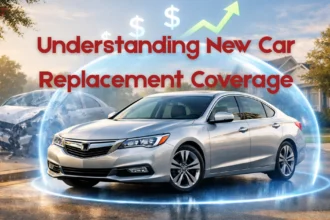
New car replacement coverage is an optional add-on to your existing auto insurance policy. If your new car is totaled in an accident or stolen, this endorsement pays you the full cost to purchase a brand-new vehicle of the same make, model, and year, rather than only the depreciated actual cash value (ACV) of your vehicle.
Standard collision and comprehensive insurance pays out what your car is worth at the time of the loss. With depreciation factored in, that number is always lower than what you originally paid. New car replacement coverage eliminates that financial gap, giving you enough money to walk onto a dealer lot and drive away in the exact same vehicle you lost.
Quick example: You buy a 2025 Honda HR-V for $28,000. Eight months later, it is totaled. Without new car replacement coverage, you might receive around $23,000 (depreciated value). With new car replacement coverage, you receive approximately $28,000, enough to buy the same car again, minus your deductible.
How Does New Car Replacement Coverage Work?
New car replacement coverage activates when your insurer declares your vehicle a total loss, meaning the repair costs exceed a certain percentage of the car’s value (typically 70-80%). Here is the step-by-step process:
- You file a claim after your car is totaled or stolen.
- Your insurer determines the vehicle is a total loss.
- Instead of calculating the depreciated ACV, the insurer determines the cost to purchase a new vehicle of the same make, model, and year.
- You receive a payout equal to that replacement cost, minus your deductible.
- You use that payout to purchase your new replacement vehicle.
One important note: modern vehicles are increasingly expensive to repair due to advanced driver-assistance systems (ADAS), cameras, and sensors built into bumpers and body panels. A minor fender bender can easily generate a $5,000 to $10,000 repair bill, which means insurers are declaring total losses more frequently than ever before, making this coverage more relevant for today’s drivers.
Who Should Get New Car Replacement Coverage?
This coverage makes the most sense for a specific group of drivers. Consider adding new car replacement coverage to your policy if:
- You purchased a brand-new vehicle within the past one to two years.
- You bought a vehicle that depreciates quickly (sports cars, luxury vehicles, certain imports).
- You drive frequently or in high-traffic areas, increasing your accident risk.
- You paid cash or put down a large down payment (gap insurance would not fully protect you).
- You want true peace of mind knowing you can replace your car like-for-like if disaster strikes.
On the other hand, new car replacement coverage may be less necessary if you drive very few miles per year, your vehicle holds its value well (Toyota and Volvo models are known for this), or you bought a lower-priced vehicle where the depreciation gap is smaller.
Which Insurance Companies Offer New Car Replacement Coverage?
Not every insurer offers new car replacement coverage. Major names like Geico, Progressive, and State Farm do not currently include it as a policy option. Here is a side-by-side comparison of the top US providers that do:
| Insurance Provider | Coverage Period | Mileage Limit | Key Notes |
| Travelers | First 5 years | No stated limit | Includes gap coverage; original owner only |
| Allstate | First 2 model years | No stated limit | Must be 2 model years old or newer |
| Farmers | First 2 years | Under 24,000 miles | Must be insured with Farmers upon purchase |
| Nationwide | 0-2 years (new); 3-5 years (comparable) | No stated limit | Not available in all states |
| Erie | First 2 years | No stated limit | Can be added any time before a loss |
| Liberty Mutual | First year | Under 15,000 miles | Original owner required |
| The Hartford | First 15 months | Under 15,000 miles | AARP policyholders only; included free |
Note: Coverage availability and terms vary by state. Always confirm with your insurer before purchasing.
How Much Does New Car Replacement Coverage Cost?
Cost is one of the most common questions drivers ask about new car replacement coverage. The short answer: it is usually quite affordable. Most insurers price this add-on at approximately 5% of your total comprehensive and collision premium.
Real-world example: One Reddit user reported their new car replacement coverage cost only $3.73 per month on their Audi policy. When their car was in an accident and faced a $27,000 repair bill on a $40,000 vehicle, their insurer was set to total it. Instead of receiving $40,000 (ACV), they stood to receive approximately $70,000, the cost of a new replacement. At $3.73 a month, that was one of the best investments they ever made.
Farmers states that its coverage typically adds 5% to 13% to your comprehensive and collision premium. If those coverages cost $100 per month, expect to pay an additional $5 to $13 per month, or roughly $60 to $156 per year, for new car replacement coverage. Some insurers, like Shelter, even include it at no extra charge.
Eligibility Requirements: What You Need to Qualify
New car replacement coverage is not available to everyone. Most insurers impose the following standard requirements:
- The vehicle must be new (not used), and you must be the original title holder.
- The car must be within a certain age window, typically one to five years, depending on the insurer.
- Mileage limits often apply, commonly under 15,000 miles.
- You must carry both collision and comprehensive coverage (often called full coverage) on the vehicle.
- The vehicle must not be a lease (though some policies may apply to leased vehicles with restrictions).
If you miss the enrollment window for one insurer, check others. Nationwide, for example, allows you to add the coverage at any point within the first six months of owning the car, as long as you have not already been in an accident.
New Car Replacement Coverage vs. Gap Insurance: Which Do You Need?
These two products are frequently confused, but they serve different purposes. Here is a clear breakdown:
| Feature | New Car Replacement | Gap Insurance |
| What it pays | Full cost of a brand-new same make/model | Difference between ACV and loan balance |
| Purpose | Replace your car with a new one | Pay off remaining loan after total loss |
| Who benefits most | Cash buyers or those wanting a new car | Drivers who owe more than their car is worth |
| Deductible applies | Yes | Often yes |
| Required by lenders | No | Sometimes yes |
| Best used after | Totaled or stolen new car | Total loss when underwater on loan |
In plain terms: gap insurance makes sure you do not owe money on a car you no longer have. New car replacement coverage makes sure you can drive away in a new one. If you financed your vehicle and also want to replace it with a new model, you may want to consider both coverages or look for a provider like Travelers, whose new car replacement policy also includes gap protection.
New Car Replacement vs. Better Car Replacement Coverage
Once your vehicle ages out of new car replacement eligibility, you may be able to transition to better car replacement coverage. Offered by insurers including Erie, Liberty Mutual, and Acuity, this coverage pays you the value of a vehicle that is one model year newer and has 15,000 fewer miles than your totaled car.
It is not as generous as new car replacement coverage, but it ensures you are still getting an upgrade rather than just the depreciated value of your old car. Many financial advisors recommend transitioning to better car replacement coverage as a logical follow-on once your new car replacement window expires.
Is New Car Replacement Coverage Worth It? What Real Drivers Say
The answer depends on your situation, but the data and real-world reviews suggest it is often worth the modest extra cost for new car owners.
According to a Bankrate analysis, new car replacement coverage typically costs around 5% of your overall premium. For most drivers, that translates to under $10 per month added to their bill.
On Reddit and consumer review platforms, policyholders who had this coverage in place at the time of a total loss report overwhelmingly positive outcomes. Drivers who did not have it frequently express regret, especially when they realize their payout falls thousands of dollars short of what they need for a comparable replacement.
Key factors to weigh when deciding:
- How much did you pay for your car, and how quickly does that model depreciate?
- How often and how far do you drive? Higher mileage means higher accident probability.
- Can you afford to make up a potential shortfall of several thousand dollars out of pocket?
- Does the extra cost (often under $10/month) fit your budget comfortably?
For most buyers of new vehicles in the $25,000 to $70,000 range, the answer is a clear yes. The math simply favors it.
5 Expert Tips for Buying New Car Replacement Coverage
- Buy it immediately. Most insurers require you to add new car replacement coverage before any accident occurs, and some have short enrollment windows. Do not wait.
- Bundle with gap insurance if you are financing. If you owe more than your car is worth, pair new car replacement with gap insurance or choose a provider like Travelers that includes both.
- Compare multiple quotes. Not all insurers price this coverage the same way. Get quotes from at least three providers.
- Know your deductible. New car replacement coverage still comes with a deductible. Make sure you have enough in savings to cover it.
- Cancel when you age out. Once your vehicle exceeds the age or mileage limit, cancel the add-on so you are not paying for coverage you no longer have.
Common Mistakes to Avoid
- Assuming all insurers offer it. Geico, Progressive, and State Farm do not offer new car replacement coverage. Shop with providers that do.
- Waiting too long to buy. Some insurers only allow enrollment within 30 days of purchase or before the first renewal.
- Confusing it with comprehensive coverage. Standard comprehensive covers theft and weather damage, but only at ACV. A new car replacement fills the depreciation gap on top of that.
- Forgetting about the deductible. Your payout will be reduced by your deductible, so plan accordingly.
Frequently Asked Questions About New Car Replacement Coverage
Does new car replacement coverage require full coverage?
Yes. In virtually all cases, you must carry both collision and comprehensive coverage (together sometimes called full coverage) to be eligible for new car replacement coverage as an add-on.
Can I get new car replacement coverage on a used car?
Generally no. Most insurers require you to be the original titleholder of a brand-new vehicle. If you bought used, gap insurance is typically the better protection to consider.
What happens if my exact make and model is no longer available?
Some insurers will pay up to 110% of your vehicle’s original MSRP if the same make and model is no longer available. Check your specific policy terms for this detail.
Is there a waiting period before coverage kicks in?
Usually not, but you typically must purchase the coverage before any accident or loss occurs. Trying to add it after a claim has been filed will not be accepted.
Does new car replacement coverage cover theft?
Yes, most policies cover theft in addition to total loss from accidents, provided you also carry comprehensive coverage.
When should I cancel new car replacement coverage?
Cancel once your vehicle exceeds the insurer’s age limit (typically two to five years) or mileage threshold (often 15,000 miles). At that point, you may want to explore better car replacement coverage as an alternative.
How quickly do new cars depreciate?
According to Kelley Blue Book, new cars lose an average of 16% of their value in the first year alone. By year two, total depreciation often reaches 30%. This rate is why new car replacement coverage is most valuable in the earliest months of ownership.
The Bottom Line: Protect Your Investment Before It Is Too Late
New car replacement coverage is one of the most straightforward insurance add-ons available, and for owners of new vehicles, it is also one of the most valuable. For a cost that often amounts to less than your daily coffee, it closes the depreciation gap that standard auto insurance leaves wide open.
With car prices continuing to rise and repair costs pushing more vehicles into total loss territory, the risk of finding yourself thousands of dollars short after an accident is very real. New car replacement coverage ensures that if the worst happens, you drive away in a new car, not just a check that falls short of getting you there.