




| $1.277 TrillionTotal U.S. credit card debt as of Q4 2025 the highest level ever recorded (Federal Reserve Bank of New York) |
Millions of Americans are carrying more debt today than at any point in history. If you are one of them, you already know the weight of it: the interest charges that seem to grow faster than your payments, the accounts that never seem to shrink, and the sense that the finish line keeps moving.
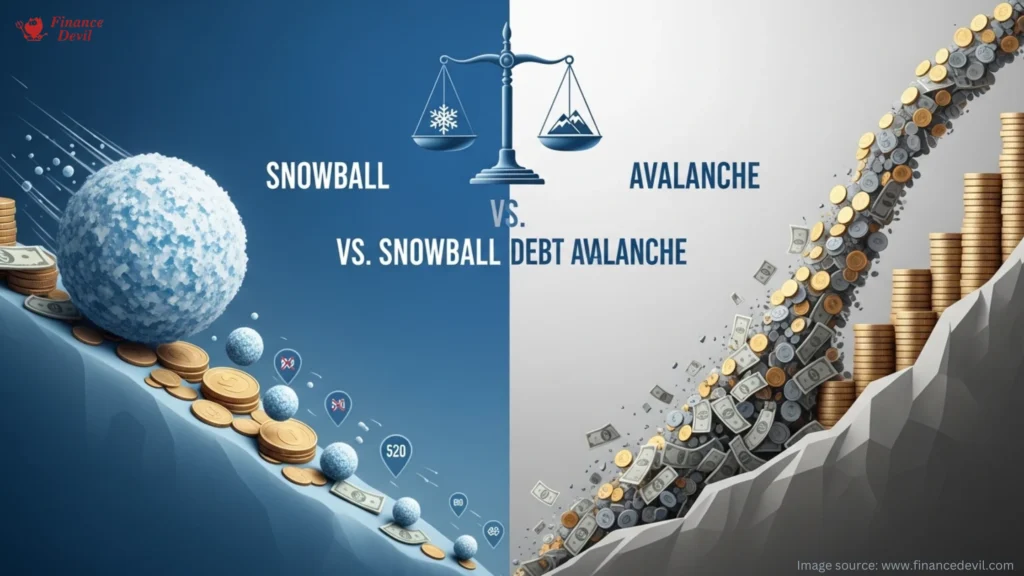
The good news is that a clear, structured plan can change all of that. Two strategies dominate the personal finance world for paying off multiple debts: the debt snowball and the debt avalanche. Both work. Both require the same basic discipline. The difference is in the order you attack your balances and that order matters more than most people realize.
This guide breaks down exactly how each method works, compares them with real numbers, and helps you decide which one fits your situation in 2026.
The State of American Debt in 2026
Before choosing a strategy, it helps to understand the landscape. According to LendingTree, total U.S. credit card balances reached $1.277 trillion in Q4 2025, the highest figure since tracking began in 1999. The average cardholder with an unpaid balance owes $7,886, while the average household carrying revolving debt holds closer to $9,148.
Bankrate’s 2026 Credit Card Debt Report found that 61 percent of Americans with card debt have been in debt for at least a year, up from 53 percent in late 2024. Meanwhile, credit card APRs remain stubbornly above 19 percent on average, meaning every month of inaction costs real money.
The path out starts with a plan. And the two most proven plans are the snowball and the avalanche.
The Debt Snowball Method: Small Wins, Big Momentum
The debt snowball strategy was popularized largely by personal finance expert Dave Ramsey. Its core idea is simple: pay off your smallest debt first, regardless of interest rate, then roll that freed-up payment into the next smallest, and keep going.
How It Works
- List all your debts from smallest balance to largest balance.
- Make minimum payments on every debt except the smallest.
- Throw all available extra money at the smallest balance.
- Once it is paid off, take that entire payment amount and add it to the minimum payment on the next debt.
- Repeat until every debt is gone.
The ‘snowball’ name reflects how your payment power grows over time. Each cleared account frees up more cash to attack the next one, so the momentum builds as you go.
| 15% HigherLikelihood of becoming debt-free with the debt snowball method vs. unstructured repayment, per a Harvard Business Review study (2024) |
The Psychology Behind the Snowball
Research consistently backs the psychological case for this method. A 2016 study in the Journal of Consumer Research found that people using the snowball approach were more likely to stick with their debt payoff plan than those using mathematically optimal methods. Quick wins create positive reinforcement that keeps motivation alive.
| “Not everyone’s income is keeping up with their cost of living, so many may go into debt not just for major purchases but for everyday purchases, too. It’s no wonder that so many Americans seem to view credit card debt payments as just another line item on their monthly budgets.”— Sara Rathner, NerdWallet Credit Cards Expert |
Who Should Use the Snowball
- You have several smaller debts you could realistically clear in the first few months.
- You have tried and failed to pay off debt before and need early momentum to stay on track.
- You feel overwhelmed by the total amount owed and need visible progress.
- You are motivated by checking things off a list.
The Debt Avalanche Method: Maximum Savings, Minimum Interest
The debt avalanche takes a different angle. Instead of targeting the smallest balance, you attack the debt with the highest interest rate first. The math is straightforward: the more expensive a debt is to carry, the more it costs you every month you hold it. Eliminate it first, and you reduce the total interest dragging down your budget.
How It Works
- List all your debts from highest interest rate to lowest.
- Make minimum payments on every debt except the one with the highest APR.
- Direct all extra money toward the highest-rate debt.
- Once paid off, roll that payment toward the debt with the next highest rate.
- Continue until all balances are cleared.
| $1,000 – $5,000+Typical additional interest savings with the avalanche method vs. snowball, for borrowers with varied APRs (Harvard Business Review analysis) |
The avalanche is the mathematically superior approach in most scenarios. LendingTree researchers modeled four different debt scenarios and found the avalanche saved between $0 and $1,292 in total interest compared to the snowball. In their most realistic scenario using average debt amounts and APRs, the difference was just $29. But in scenarios where a borrower carries a significant balance at a high APR (say, $9,000 on a 24 percent credit card), the savings can be much larger.
Who Should Use the Avalanche
- You are comfortable delaying early wins in exchange for lower total interest paid.
- You have at least one debt with a significantly higher interest rate than the rest.
- You are disciplined and motivated by numbers rather than quick victories.
- You carry large balances on high-APR credit cards.
Debt Snowball vs. Debt Avalanche: Side-by-Side Comparison
Here is a direct comparison to help you weigh both strategies at a glance.
| Factor | Debt Snowball | Debt Avalanche |
|---|---|---|
| Priority Order | Smallest balance first | Highest interest rate first |
| Interest Savings | Lower savings overall | Maximum savings possible |
| Speed to First Win | Faster (weeks to months) | Slower (can take many months) |
| Motivation Factor | High quick early wins | Requires patience and discipline |
| Best For | Those who need momentum | Disciplined, numbers-driven people |
| Total Interest Paid | Slightly higher | Lower or equal |
| Completion Rate | Higher (psychological boost) | Lower if motivation fades |
| Complexity | Simple and intuitive | Requires rate tracking |
Real Numbers: How the Two Methods Compare
The best way to understand the difference is with an example. Assume you have three debts and can put $200 per month in extra payments on top of minimums:
| Debt | Balance | APR |
|---|---|---|
| Credit Card A | $2,200 | 24% |
| Personal Loan | $6,500 | 11% |
| Medical Bill | $900 | 0% |
With the snowball method, you would clear the medical bill first ($900), then Credit Card A ($2,200), then the personal loan. You get your first win within a few months.
With the avalanche method, you attack Credit Card A first (24% APR), then the personal loan (11%), then the medical bill (0%). You pay less total interest but your first payoff takes longer.
In cases where the highest-rate debt also has a large balance, the gap widens further. Research via CuratedTools shows that when a borrower holds $15,000 on a 26 percent APR card against a $2,000 loan at 9 percent, the avalanche advantage can stretch into thousands of dollars in saved interest.
The Hybrid Approach: Getting the Best of Both
If neither pure method feels like a perfect fit, a hybrid strategy is entirely valid. The most common version works like this:
- Use the snowball to clear one or two small debts in the first 30 to 90 days.
- Once you have built some momentum and cleared the psychological hurdle of your first account, switch to the avalanche for the remaining balances.
- Evaluate your highest-rate debt and direct all extra payments there going forward.
Surplus Budget notes that when your smallest debt also carries a high interest rate or a rate close to the highest in your portfolio, the two methods naturally converge anyway. In those cases, following either method leads to the same first target. Choose whichever label keeps you motivated.
There is no rule that says you must follow one method exclusively for the duration of your payoff journey. What matters is that you have a plan, you stick to the fundamentals (minimum payments on everything, extra money toward the target), and you keep going.
Tools That Accelerate Either Method
Both strategies benefit from tactics that reduce the interest you are fighting against. Before choosing snowball or avalanche, consider whether any of these apply to your situation:
Balance Transfer Cards
If you qualify for a 0% APR balance transfer offer (typically 12 to 21 months), moving a high-rate balance to one of these cards effectively eliminates the interest during the promotional period. Every extra dollar you pay goes directly to principal. This works well alongside either payoff method.
Debt Consolidation Loans
A personal loan at a lower rate than your existing credit card APRs can reduce the total interest dragging against your payments. If you can consolidate multiple high-rate balances into a single loan at, say, 10 to 13 percent significantly lower than the average card rate of over 22 percent you shrink the math problem considerably.
Automating Extra Payments
One of the most common reasons debt payoff plans stall is forgetting to make the extra payment or spending that money before it reaches the target account. Automating a fixed extra payment each month removes that friction entirely.
Windfalls and Side Income
Tax refunds, bonuses, and freelance income applied directly to your target debt can compress your payoff timeline dramatically. Even a single $1,000 payment can eliminate months of progress.
| $18,500+Estimated total interest a person making only minimum payments on the average credit card balance would pay before clearing it completely, per NerdWallet analysis |
Common Mistakes to Avoid With Either Method
- Missing minimum payments: Late fees and penalty APRs can undo weeks of progress. Always pay at least the minimum on every account, every month.
- Adding new debt while paying down existing balances: This is the most common reason plans fail. Paying down a card while continuing to charge new purchases is counterproductive.
- Choosing the wrong method for your personality: A mathematically perfect plan you abandon after two months is worse than a slightly less efficient plan you finish. Be honest with yourself.
- Not revisiting the plan when circumstances change: A job change, medical expense, or windfall all warrant a fresh look at your payoff order and monthly target amounts.
- Neglecting an emergency fund: Without a small buffer (even $500 to $1,000), one unexpected expense can derail the plan entirely and send new charges to the credit cards you are trying to pay off.
| “Credit card debt may be a part of your everyday life, but it doesn’t have to be a part of your life forever. There are tools and resources out there that can help you make a plan to pay down your debt.”— Sara Rathner, NerdWallet Credit Cards Expert |
How to Choose the Right Strategy for You
The decision ultimately comes down to two questions: What motivates you, and what does your debt portfolio look like?
| Choose Snowball If… | Choose Avalanche If… |
|---|---|
| You need early momentum to stay motivated | You are driven by numbers and financial efficiency |
| You have failed at debt payoff plans before | You have patience to wait for the first payoff win |
| You have several small debts to knock out quickly | One debt has a significantly higher APR than the rest |
| The psychological win of closing an account matters to you | Paying the least possible interest is the top priority |
The Bottom Line
The debt snowball and debt avalanche are both effective, proven frameworks for climbing out of debt. The difference in total interest paid between the two methods is often smaller than people assume and the most important variable in any debt payoff plan is not the method you choose but whether you stick with it.
With U.S. household debt at record levels and credit card APRs remaining above 22 percent, the cost of inaction is high. Whether you start with the quick win of a small balance or the efficiency of attacking your highest-rate account, starting is what matters most.
Pick the method that matches your psychology, automate what you can, avoid adding new debt, and revisit your plan when life changes. The debt-free finish line is closer than it looks, especially once the momentum starts building.
Frequently Asked Questions
Is the debt snowball or avalanche method better?
Neither is universally better. The avalanche typically saves more interest, but the snowball has a higher completion rate for people who need early wins to stay motivated. The best method is the one you will actually follow through to the end.
How much more interest does the snowball cost compared to the avalanche?
The gap varies widely based on your specific debt mix. Research from LendingTree found that in the most realistic average-debt scenario, the difference was just $29. In scenarios with large high-APR balances, the avalanche can save $1,000 to $1,292 or more.
Can I switch from snowball to avalanche mid-plan?
Yes. Your debt payoff strategy is not a legal contract. Many people use the snowball to knock out one or two small debts, build momentum, and then switch to the avalanche for the larger remaining balances. This hybrid approach is valid and often effective.
What is the first step to start either method?
List every debt you owe, including the balance, interest rate, and minimum monthly payment. For the snowball, sort them from smallest to largest balance. For the avalanche, sort from highest to lowest interest rate. Then calculate how much extra you can apply each month beyond the minimum payments.
Does the debt snowball work for student loans?
Yes. Both methods apply to any mix of debts, including student loans, car loans, medical bills, and credit cards. If your student loan has a lower interest rate than your credit cards (which is typical), the avalanche would have you pay the credit cards first while making minimums on the student loan.
What if I can only afford minimum payments right now?
Focus first on freeing up any extra money reducing discretionary spending, picking up additional income, or pausing non-essential subscriptions. Even $25 to $50 extra per month accelerates payoff meaningfully. If your debt is unmanageable even at minimums, a nonprofit credit counselor through the NFCC can help you explore options like a debt management plan.
Does paying off debt early hurt my credit score?
Closing accounts can slightly lower your score by reducing your available credit limit, but the reduction is typically small and temporary. The bigger impact on your credit score comes from consistently making on-time payments and reducing your credit utilization ratio, both of which both payoff methods naturally support.
How long does it take to pay off debt using these methods?
The timeline depends entirely on your total debt load, interest rates, and how much extra you can pay each month. With a dedicated extra payment of a few hundred dollars monthly, most people can clear $10,000 to $20,000 in credit card debt within two to four years. Using a debt payoff calculator with your real numbers will give you a personalized projection.
Sources and Citations
1. LendingTree — 2026 Credit Card Debt Statistics
2. Bankrate — 2026 Credit Card Debt Report
3. NerdWallet — 2025 Household Credit Card Debt Study
4. LendingTree — Debt Avalanche vs. Snowball Effectiveness Study
5. Surplus Budget — Debt Snowball vs. Avalanche (2026)
6. Federal Reserve Bank of New York — Household Debt and Credit Report