

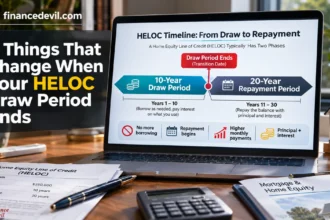



A home equity line of credit (HELOC) has two phases. In the draw period, usually up to 10 years, you borrow and repay freely, often paying interest only. The repayment period that follows works like a regular loan. The handoff is where budgets break.
More borrowers face it every quarter. HELOC balances rose by $23 billion in the third quarter of 2026 to $481 billion, the largest quarterly jump since 2005, according to the Federal Reserve Bank of New York.
| Key Takeaways: Most lenders send a notice at least six months before the draw period ends, and the end date is usually printed on your statement.Moving from interest-only to a fully amortizing payment raised our $60,000 example by 29% (20-year term) to 90% (10-year term) at a 7.47% rate.You can no longer draw on the line. A small share of HELOCs requires the full balance as a balloon payment instead.The rate usually stays variable. With the prime rate at 7.00% (Oct. 2026), each 1-point rise adds about $37 a month to a $60,000, 20-year repayment.Exits include renewing into a new HELOC, a fixed home equity loan, a cash-out refinance at 7.28% (Freddie Mac, Nov. 19, 2026), or paying the balance down before repayment starts. |
What changes when a HELOC draw period ends? (Summary table)
The end of a HELOC draw period changes six things at once. This matrix shows each change and the move that softens it.
Table 1. The six changes at a glance
| Change | What happens | Your best counter-move |
|---|---|---|
| 1. A deadline appears | Lender notice arrives, often 6+ months out | Pull your agreement and confirm the conversion terms |
| 2. Payment jumps | Interest-only becomes principal + interest | Pay principal early or choose a longer repayment term |
| 3. Draws stop | Line closes to new borrowing; rare balloon due | Line up a backup source of cash first |
| 4. Rate risk hits harder | Variable rate now applies to a shrinking-balance loan | Ask about a fixed-rate lock or a fixed loan |
| 5. Credit and DTI shift | Bigger required payment counts against your DTI | Refinance before applying for other credit |
| 6. Exit options open | Renew, refinance, fix the rate, or pay off | Compare total cost, not just the monthly payment |
Source: FinanceDevil analysis of lender disclosures summarized by Bankrate and Experian.
1. When does the draw period end, and how much warning do you get?
Your HELOC draw period ends on a fixed date written into your loan agreement, and most lenders warn you at least six months ahead. Bankrate reports that the termination date usually appears on your monthly statement as well. That notice is the start of a decision window, not a formality.
Verdict: Treat the six-month notice as the deadline for every option on this list, because refinancing takes weeks and appraisals can surprise you.
- Typical draw length: up to 10 years, with some lines as short as three or five years (Bankrate).
- Typical repayment length: often 10 to 20 years once the draw period closes (Benzinga, citing the CFPB, Nov. 2026).
- Start early: LendingTree advises reviewing refinance and renewal options several months ahead.
- Questions to ask now: when repayment begins, whether the rate resets, whether it will be fixed or variable, and how much the payment changes (TD Bank guidance summarized by Bankrate).
Example: A Charlotte, North Carolina, couple who opened a 10-year line in December 2016 will see repayment begin in December 2026. A June notice gave them about six months to compare a renewal, a fixed loan, and a payoff plan.
Who this fits: anyone within 12 months of their end date.
Who can skip it: borrowers with a zero balance, since many lines with nothing owed simply close at the end of the draw.
2. How much will my HELOC payment go up when repayment starts?
Your HELOC payment goes up because the lender starts collecting principal, not just interest, and the size of the jump depends mostly on the repayment term. PNC notes the required payment may increase substantially, particularly for borrowers who made interest-only payments during the draw.
Verdict: The shorter the repayment term, the bigger the jump: a 10-year schedule nearly doubled our example payment.
The national average HELOC rate was 7.47% as of November 18, 2026, according to Bankrate’s lender survey. We used that rate on a $60,000 balance. All figures below were calculated in code by FinanceDevil.
Table 2. Worked example: $60,000 HELOC balance at the end of the draw period
| Payment schedule | Monthly payment | Increase vs. interest-only | % increase | Total interest over term |
|---|---|---|---|---|
| Interest-only (draw period) | $373.50 | n/a | n/a | n/a |
| 20-year repayment at 7.47% | $482.26 | +$108.76 | +29.1% | $55,741 |
| 15-year repayment at 7.47% | $555.19 | +$181.69 | +48.6% | $39,933 |
| 10-year repayment at 7.47% | $711.27 | +$337.77 | +90.4% | $25,353 |
| 20-year repayment at 8.47% (rate +1 point) | $519.56 | +$146.06 | +39.1% | $64,693 |
Rate: Bankrate national average HELOC rate, as of Nov. 18, 2026 (Bankrate). Assumes full amortization at a constant rate; your lender’s terms may differ.
| FinanceDevil Insight: the “gentle” payment costs the mostThe 20-year schedule raises the payment by only $108.76, but it costs $30,389 more in interest than the 10-year schedule. Take the long term to survive the transition if you must, then prepay once your budget settles. |
Who this fits: anyone who budgeted around the interest-only payment.
Who can skip it: borrowers who already paid principal during the draw, because their balance and payment jump will be smaller.
3. Can I still borrow from my HELOC after the draw period ends?
Once the draw period closes, you can no longer borrow from the line, and checks or cards tied to it stop working. Experian explains that the line of credit is closed at that point and you repay what you drew.
Verdict: If your HELOC doubles as your emergency fund, replace it before the end date, not after.
- Balloon risk: some HELOCs require the entire balance, principal and interest, at the end of the draw instead of a repayment period (Experian).
- Renewal option: some lenders let you renew into a new line, which restarts a draw period, but you must reapply and requalify (Experian).
- Unused credit: HELOC limits rose $31 billion in Q3 2026 (New York Fed), and unused room on a line expires with the draw period.
Example: A Phoenix homeowner who planned to draw $15,000 for a roof in 2027 should do the work or line up a separate loan before the line closes. Afterward, it means a new application and today’s pricing.
| State callout: Texas HELOCs follow constitutional rulesTexas writes its home equity rules into Article XVI, Section 50 of the state constitution. Every advance on a Texas HELOC must be at least $4,000, total home-secured debt is capped at 80% of the home’s value when the line is made, and only one home equity loan or line can be secured by the homestead at a time. So a Texas replacement loan must pay off the old line rather than sit beside it. |
Who this fits: borrowers who still need access to funds.
Who can skip it: anyone who fully drew the line for a single project and has no further borrowing plans.
4. Does my HELOC rate change when the repayment period starts?
In most cases your HELOC rate stays variable through repayment, and the difference is that every rate move now hits a payment that includes principal. HELOC rates usually track the prime rate, which stood at 7.00% after the Federal Reserve held its target range at 3.75% to 4.00% in October 2026 (NerdWallet).
Verdict: Assume rates will not bail you out, and price your repayment budget at least one point higher than today’s rate.
- Rate direction: markets were pricing one more quarter-point hike in 2026 after the Oct. 28 meeting (Advisor Perspectives).
- Sensitivity: a 1-point rise adds $37.30 a month to our $60,000, 20-year repayment (FinanceDevil calculation).
- Caps: most HELOC rates carry a lifetime cap (Bankrate).
| Expert view“Using a HELOC today requires the understanding that rates may not fall quickly.”Stephen Kates, a former Bankrate financial analyst, was quoted in Bankrate’s November 2026 HELOC rate survey |
Example: A Denver borrower with a $45,000 balance asks the lender about a fixed-rate lock option. Locking part of the balance turns a moving bill into a fixed installment, sometimes for a fee or a slightly higher rate.
Who this fits: borrowers with large balances or tight budgets.
Who can skip it: borrowers who can comfortably absorb a 1- to 2-point rate rise or plan to pay off within a year.
5. How does the end of the draw period affect my credit and debt-to-income ratio?
The end of the draw period does not hurt your credit by itself, but the bigger required payment raises your debt-to-income ratio (DTI), the share of gross monthly income that goes to debt payments. Lenders use DTI to approve mortgages, auto loans, and new credit lines.
Verdict: Refinance or restructure before you apply for other credit, because underwriters will count the new, higher payment.
- Scoring: FICO scores are designed to exclude HELOCs from credit utilization, but VantageScore models may count the balance and limit (Experian).
- History: a closed HELOC in good standing can stay on your credit reports for up to 10 years (Experian).
- Delinquency trend: the share of HELOC balances moving into serious delinquency was 1.17% in Q3 2026, down from 1.27% a year earlier (New York Fed).
Example: A Michigan borrower earning $7,000 a month with $2,100 in other debt payments sits at a 35.3% DTI with the $373.50 interest-only payment. The $711.27 10-year payment pushes DTI to 40.2%, enough to change the terms on a new car loan.
Who this fits: anyone planning a big credit application in the next year.
Who can skip it: borrowers with low DTI and no upcoming loan applications.
6. What are my options to refinance or pay off a HELOC when the draw period ends?
When the draw period ends, you can repay on schedule, renew into a new HELOC, convert to a fixed home equity loan, fold the balance into a cash-out refinance, or pay it down with savings or a personal loan. Bankrate lists the same core exits; the right one depends on your first-mortgage rate.
Verdict: If your first mortgage rate is far below 7%, keep it and fix the HELOC separately; a cash-out refinance only wins when it lowers your blended rate.
Table 3. Your exit options compared (rates as of November 2026)
| Option | Typical rate | Best for | Watch out for |
|---|---|---|---|
| Repay on schedule | 7.47% avg HELOC, variable | Stable income, small balance | Payment jump; rate rises |
| Renew into a new HELOC | Similar to new-line pricing | Still need flexible access | Restarts interest-only habit; new fees |
| Fixed home equity loan | 8.268% (10-yr), 8.280% (15-yr) | Wants a fixed payment, keeps first mortgage | Higher rate than HELOC average |
| Cash-out refinance | 7.28% (30-yr fixed avg) | First mortgage rate above about 7% | Closing costs; resets the whole mortgage |
| Pay down before repayment | n/a | Savings or a bonus available | Draining emergency cash |
Sources: HELOC rate from Bankrate, Nov. 18, 2026; home equity loan rates from MRC data via Fortune, Nov. 10, 2026; 30-year fixed rate from Freddie Mac PMMS, Nov. 19, 2026.
Low-rate homeowners are protecting their first mortgages: the St. Louis Fed found the share of housing-debt borrowers holding a HELOC rose from 9.18% in early 2022 to 10.82% in early 2026.
Example: A Raleigh homeowner with a 3.1% first mortgage and a $60,000 HELOC compares a 15-year home equity loan at 8.28% ($583.13 a month) with 15-year HELOC repayment at 7.47% ($555.19). The fixed loan costs $27.94 more monthly but removes rate risk; a cash-out refinance would reprice the 3.1% mortgage, so it is out.
Who this fits: every borrower with a balance at the end date.
Who can skip it: nobody, since the default terms may not beat these alternatives. For the head-to-head math, see our guide to the 6 differences between a HELOC and a home equity loan.
What changed for HELOC borrowers in 2026?
Three 2026 developments shape the end-of-draw decision: record balance growth, a Fed pause at 3.75% to 4.00% instead of cuts, and permanent tax rules. Under the One Big Beautiful Bill Act, interest is deductible only when the money buys, builds, or substantially improves the home securing the loan, and that limit no longer expires (CPA Practice Advisor, Oct. 2026). Paying down a line used for debt consolidation costs you no deduction.
If you are still shopping for a line, our checklist of 7 questions to ask before you sign a HELOC agreement covers the conversion terms to lock down on day one. Borrowers worried about a downturn should also read 5 things that happen to your HELOC when the economy turns.
Frequently asked questions about the end of a HELOC draw period
What happens when a HELOC draw period ends?
When a HELOC draw period ends, you can no longer borrow from the line, and your payment typically changes from interest-only to principal plus interest over a repayment period that often lasts 10 to 20 years. Some HELOCs instead require the full balance as a balloon payment, so check your agreement well before the end date.
How much does a HELOC payment increase after the draw period?
It depends on your balance, rate, and repayment term. On a $60,000 balance at 7.47%, the payment rises from $373.50 interest-only to $482.26 over 20 years, $555.19 over 15 years, or $711.27 over 10 years. That is an increase of roughly 29% to 90%, based on FinanceDevil calculations using November 2026 rates.
Can I extend my HELOC draw period?
You usually cannot extend the original draw period, but some lenders let you renew the line, which means applying for a new HELOC that pays off the old one and starts a fresh draw period. Renewal means requalifying on credit, income, and home value.
Do I need to refinance my HELOC when the draw period ends?
No. Most HELOCs convert automatically into a repayment period, so refinancing is optional. It makes sense when the new payment strains your budget, you want a fixed rate, or a balloon is due. Compare total interest, not just the monthly payment.
Will my credit score drop when my HELOC enters repayment?
Entering repayment does not lower your score on its own. FICO scores are designed to exclude HELOCs from utilization, though VantageScore models may count them. The real risk is a missed payment after the jump, which can damage your credit and, because the line is secured by your home, put the property at risk.
What is a HELOC balloon payment?
A HELOC balloon payment means the entire remaining balance is due in one lump sum when the draw period ends, instead of being repaid in installments. Balloons are less common than amortizing repayment. If yours has one, plan a refinance or payoff months ahead, because the deadline is fixed.
Is a home equity loan better than keeping my HELOC in repayment?
A home equity loan is better if you value a fixed payment more than a lower starting rate. In November 2026, 15-year home equity loans averaged about 8.28% versus 7.47% for HELOCs, so you pay a premium for certainty. For a $60,000 balance over 15 years, that premium was about $28 a month.
Should I use a cash-out refinance to pay off my HELOC?
Only if the new mortgage rate lowers your overall borrowing cost. The 30-year fixed rate averaged 7.28% on November 19, 2026, according to Freddie Mac. Homeowners with lower first-mortgage rates usually pay more by refinancing everything, so a separate home equity loan or renewal is often cheaper.
Is HELOC interest still tax deductible in 2026?
HELOC interest is deductible in 2026 only if you itemize and the borrowed money was used to buy, build, or substantially improve the home that secures the line, within the $750,000 mortgage debt limit. The One Big Beautiful Bill Act made this rule permanent. Interest on money used for other purposes is not deductible.
What happens if I cannot afford my HELOC payment after the draw period?
Contact your lender before you miss a payment; some offer modifications, term extensions, or fixed-rate conversions, and refinancing into a longer term is another route. Ignoring the problem is risky because a HELOC is secured by your home, and default on a second lien can lead to foreclosure even if your first mortgage is current.
Related reading: 9 ways to use a HELOC wisely (and 3 ways to ruin your finances with one) and, if a full refinance tempts you, 6 signs refinancing will actually save you money in 2026.
| Disclaimer: This article is for educational purposes only and is not financial, legal, or tax advice. Rates, terms, and tax rules change and vary by lender, state, and borrower profile. Examples are illustrations, not offers. Consult your lender and a qualified financial or tax professional before making borrowing decisions. |
Sources
- Bankrate, “Current HELOC rates,” national average as of Nov. 18, 2026.
- Bankrate, “What to do when your HELOC draw period ends,” Oct. 20, 2025.
- Federal Reserve Bank of New York, Q3 2026 Household Debt and Credit press release, Nov. 10, 2026.
- Federal Reserve Bank of New York, Quarterly Report on Household Debt and Credit, 2026:Q3.
- Freddie Mac, Primary Mortgage Market Survey, Nov. 19, 2026.
- NerdWallet, “How the Fed Rate Affects Small-Business Loans” (prime rate 7%), Oct. 2026.
- Advisor Perspectives, “Fed’s Interest Rate Decision: October 28, 2026.”
- Experian, “How Does a HELOC Affect Your Credit Score?”
- Experian, “How Does HELOC Repayment Work?”
- LendingTree, “HELOC Draw Period Ending? Here’s What to Expect.”
- Fortune (MRC data), “Today’s home equity loan and HELOC rates, Nov. 10, 2026.”
- Texas Constitution, Article XVI, Section 50 (home equity lending).
- Federal Reserve Bank of St. Louis, “Tracking the Shift from Mortgage Refinancings to HELOCs,” June 2026.
- CPA Practice Advisor, “How to Unlock Mortgage Interest Deductions for Home Improvements,” Oct. 28, 2026.
- Benzinga, “Homeowners Borrow More Against Their Homes…,” Nov. 2026.
- PNC, “What Is a HELOC Draw Period?”