
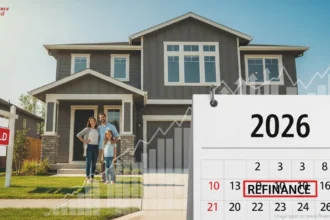



Mortgage rates have fallen sharply from their 2023-2024 peaks, and refinance applications are surging. But a lower rate alone is not the whole story. Here is what every homeowner needs to know before making a move.
If you bought a home in the last two to three years, you probably signed the papers with a knot in your stomach. Mortgage rates had climbed from pandemic-era lows of under 3% all the way past 7% and, briefly in late 2023, pushed close to 8%. The monthly payment felt steep, but you needed the house. You told yourself rates would come down eventually. Well, eventually is here.
Rates have been trending down steadily since mid-2025, and the housing market has responded accordingly. Refinance applications have surged to multi-year highs, lender phone lines are jammed, and online mortgage platforms have seen record traffic. But the question worth asking before you join the queue is not simply “are rates lower?” It is “Does a refinance actually make financial sense for my specific situation?”
This guide walks through the current rate environment, the different types of refinances available, the costs involved, how to calculate whether it is worth it, and what qualifications lenders look for right now.
| 6.22%Avg. 30-yr fixed refinance rate (Freddie Mac, Mar 19, 2026) | 69%Year-over-year rise in refinance applications (MBA, Mar 18, 2026) | 82.8%Homeowners with a mortgage rate below 6% as of Q3 2024 (Redfin) |
Where Mortgage Rates Stand Right Now
After starting 2025 near 7%, rates fell below 6% briefly at the start of 2026, according to reporting from U.S. News, making it the first time that threshold had been crossed in 3.5 years. That sparked a wave of refinance applications almost overnight.
Since then, rates have ticked back slightly. Freddie Mac’s benchmark sat at 6.22% for the week ending March 19, 2026, while Zillow’s lender marketplace was showing a 30-year refinance APR closer to 6.78% as of the same date, per CBS News. The 15-year refinance option is more attractive, coming in around 5.90% to 6.00% depending on the source.
| Loan Type | Avg Rate (Mar 2026) | Source |
| 30-year fixed refinance | 6.22% – 6.78% | Freddie Mac / Zillow |
| 15-year fixed refinance | 5.90% – 6.00% | Bankrate / CBS News |
| 30-yr fixed (purchase) | 6.27% | Bankrate weekly survey |
MBA data released on March 18 showed the Refinance Index had climbed 69% from the same week a year ago, even as rates edged up from their recent lows. That sustained demand tells you that many homeowners who locked in rates above 7% are still finding the math compelling.
What do forecasters think happens next? The MBA expects the 30-year rate to hover near 6.10% through end of 2026, while Fannie Mae projects a similar trajectory. Jeff DerGurahian, chief investment officer at loanDepot, believes rates could move into the 5.5% range by midyear if inflation continues to cool. That said, economic forecasting is not a precision sport.
| “If refinancing today creates meaningful savings, it is the right time to begin making those savings now.”— Loren Fellows, SVP Mortgage Production Manager, Johnson Financial Group |
The Refinance Surge: What the Data Shows
MBA data for the week ending February 20, 2026, showed refinance applications had jumped 150% compared to the same week in 2025. For a stretch in January and February, refinancing accounted for over 58% of all mortgage applications processed nationwide.
The January rate drop to 6.04% was especially significant. ICE Mortgage Technology’s February 2026 Mortgage Monitor reported that this single dip gave roughly 4.8 million borrowers a realistic window to refinance, pushing housing affordability to a four-year high.
Who is doing the refinancing? Primarily homeowners who bought in 2023 and 2024. Meanwhile, Redfin data shows 82.8% of homeowners with a mortgage had a rate below 6% as of Q3 2024. For those borrowers, current rates offer little incentive to refinance.
Types of Refinance: Which One Fits Your Situation?
Rate-and-Term Refinance
This is the most common type. You replace your existing mortgage with a new one at a lower rate, a different term, or both. The loan balance stays roughly the same. It is the right move if your primary goal is reducing your monthly payment or cutting total interest paid.
Cash-Out Refinance
You refinance for more than you currently owe and receive the difference in cash. If your home has appreciated, this lets you tap that equity for renovations or debt consolidation. Bankrate notes that Fannie Mae and Freddie Mac impose additional loan-level price adjustments on cash-out loans, particularly for borrowers with lower credit scores.
Streamline Refinance
Available for government-backed loans (FHA, VA, USDA), streamline refinances involve less paperwork, often no appraisal, and faster processing. The VA’s IRRRL program has a funding fee of just 0.5% of the loan amount.
No-Closing-Cost Refinance
You refinance without paying upfront closing costs, but those costs get rolled into your loan balance or offset through a slightly higher rate (typically 0.25% to 0.50%). This makes sense if you plan to sell or refinance again within a few years.
The Real Costs of Refinancing
NerdWallet cites a Freddie Mac report putting the average cost of a mortgage refinance at $5,000. Rocket Mortgage pegs typical closing costs at 3% to 6% of the loan amount, which on a $300,000 refinance translates to $9,000 to $18,000. Here is what those costs typically include:
- Origination fee: typically 0.5% to 1% of the loan amount
- Appraisal fee: $300 to $800 or more depending on the property
- Title search and insurance: required because the loan terms are changing
- Escrow setup fees and application fee (charged by some lenders)
- Prepaid interest: you pay interest from your closing date through end of that month
- Tax service and flood certification fees
| Pro Tip: Close Later in the MonthClosing near the end of the month reduces your prepaid interest significantly.On a $300,000 loan at 6.5%, daily interest runs about $53. Closing on the 28th instead of the 5th saves you roughly $1,200 in prepaid interest at closing. |
How to Calculate Your Break-Even Point
Before you call a lender, run this number. Your break-even point is how long it takes for your cumulative monthly savings to exceed your upfront closing costs. If you plan to sell or move before that date, refinancing will cost you money, not save it.
| The Break-Even FormulaTotal Closing Costs / Monthly Payment Savings = Break-Even (months)Example: You currently pay $2,100/month. After refinancing, your payment drops to $1,800 (saving $300/month). Your closing costs are $5,100.$5,100 / $300 = 17 months to break even.If you plan to stay longer than 17 months, the refinance generates real savings. |
The Rocket Mortgage break-even framework walks through a similar example: a $300 monthly saving against $5,000 in closing costs produces a break-even of roughly 17 months. New American Funding’s VP of mortgage lending puts it plainly: “The longer you stay in the home, the more money you’ll save over the long term.”
Does a 1% Rate Drop Actually Matter?
The old “1% rule” is a rough starting point, but the reality is more nuanced. The Mortgage Reports points out that even a 0.5% reduction might justify refinancing if you plan to stay long enough. On a $300,000 loan, a 0.5% reduction saves roughly $1,200 annually. On a $500,000 loan, that jumps to about $2,000 per year.
| “Refinancing should be based on today’s reality versus tomorrow’s speculation. If the rate available today offers meaningful savings after accounting for closing costs, it is wise to lock that rate in now.”— Loren Fellows, SVP Mortgage Production Manager, Johnson Financial Group |
The corollary is also true: holding out for a projected lower rate is a gamble. As Fellows points out, if you lock in a refinance that saves you $300 per month and wait six months instead, you have left $1,800 on the table, money that could have been applied against your closing costs from day one.
Qualification Requirements in 2026
Credit Score
Most conventional refinances require a minimum FICO score of 620, but to access the best rates you generally want to be above 720. Cash-out refinances are held to a higher standard.
Home Equity
For a standard rate-and-term refinance, you typically need at least 3% to 5% equity. To avoid PMI on the new loan, you need 20%. Cash-out refinances require you to leave at least 20% equity in the property.
Debt-to-Income (DTI) Ratio
Most lenders want your total monthly debt payments to stay below 43% of your gross monthly income. Some loan programs allow up to 50%, but a lower DTI gets you better rates.
Income Verification
You will need recent pay stubs, W-2s, and possibly tax returns. Self-employed borrowers often face additional requirements including profit and loss statements.
Waiting Periods
Most conventional lenders require at least six months of on-time payments before you can refinance. For cash-out refinances, the standard is typically 12 months from the original closing date.
Step-by-Step: How to Refinance Your Mortgage
- Review your current mortgage terms. Know your current rate, remaining balance, monthly payment (P&I only), and months remaining. This is your baseline for every comparison.
- Check your credit score and report. Pull your free reports at AnnualCreditReport.com. Dispute any errors before applying.
- Estimate your home’s current value. Use Zillow or Redfin for a rough figure. A formal appraisal will be required, but you need this to understand your equity position.
- Shop at least three lenders. Rate differences of 0.25% to 0.50% between lenders add up to tens of thousands of dollars over the life of a loan. Multiple applications in a short window count as one hard inquiry.
- Compare Loan Estimates side by side. Each lender must provide a standardized Loan Estimate within three business days. Compare rate, APR, closing costs, monthly payment, and term.
- Calculate your break-even point. Use the formula above. If the break-even date is before you plan to sell, reconsider the timing.
- Lock your rate. Once satisfied, lock your rate. Locks typically last 30 to 60 days.
- Prepare your documentation. Gather: 30 days of pay stubs, 2 years of W-2s, 2 months of bank statements, 2 years of tax returns (if self-employed), and your homeowner’s insurance policy.
- Close on the loan. Review the Closing Disclosure at least three business days before closing. Attend, sign, and fund.
When Refinancing Does NOT Make Sense
Not every homeowner should rush to refinance, even if rates are lower. Here are the situations where holding off is the smarter call.
- You plan to sell within the next one to three years and cannot reach your break-even point
- Your credit score has dropped significantly since your original mortgage
- You are already 20 or more years into a 30-year mortgage; resetting extends your total interest significantly
- Your current mortgage has a prepayment penalty clause
- Your income or employment has become less stable
- You are carrying a mortgage rate below 4% or 5%, which still beats current market rates
Bankrate’s analysts note that many Americans are locked into rates under 5%, and for those borrowers, as long as rates remain above 6%, the incentive to refinance is limited.
The 2026 Opportunity Window: Is It Closing?
Rates briefly touched below 6% in early January 2026 and have since drifted back toward the mid-6% range. Own Up’s 2026 refinancing trend analysis notes that while the Federal Reserve has signaled additional rate cuts this year, uncertainty around inflation and tariffs makes the outlook murkier than it might appear.
| “If you are one of the millions of homeowners who purchased at the high rates of the last few years, you will likely find 2026 an attractive window to refinance.”— Jeff DerGurahian, Chief Investment Officer, loanDepot |
Quick Checklist: Are You Ready to Refinance?
- Your current rate is at least 0.5% to 1% higher than today’s available rates
- You plan to stay in the home beyond your calculated break-even point
- Your credit score is 680 or above
- You have at least 5% to 20% equity in the property
- Your DTI ratio is below 43% with the new proposed payment
- You have stable, verifiable income
- You have 3% to 6% of your loan amount available for closing costs
| One More Thing Worth KnowingRefinancing creates a hard inquiry on your credit report and temporarily reduces your score by a few points.It also closes your old mortgage and opens a new one, slightly lowering the average age of your credit history.Both effects are typically minor and reverse within a few months of on-time payments on the new loan. |
Bottom Line
For homeowners who locked in rates between 7% and 8% in 2023 and 2024, the refinance math has become genuinely compelling. Rates have fallen roughly a full percentage point from their peak, refinance applications are surging, and expert consensus suggests rates could ease further into the 5.5% to 6.0% range by midyear if the macro environment cooperates.
But compelling is not the same as automatic. Run your own break-even calculation, verify your equity position, review your credit, and get quotes from multiple lenders before committing. The best refinance is the one where the numbers work for your specific situation.
If you are a homeowner with a rate above 7%, there is a strong case for acting now rather than waiting for a bottom that may or may not materialize. If you are sitting on a pandemic-era rate below 4%, there is likely no refinance that makes sense in the current environment, and that is perfectly fine.
Sources
- U.S. News & World Report: Mortgage Rates on the Decline: Should You Refinance in 2026? (Feb. 26, 2026)
- Bankrate: Current Refinance Rates, including MBA data (March 19, 2026)
- Fortune: Current Refi Mortgage Rates, March 20, 2026
- CBS News: Today’s Mortgage Interest Rates, March 20, 2026
- Money.com: Current Mortgage Rates, March 16-20, 2026
- HousingWire: Mortgage Affordability at Four-Year High (ICE Mortgage Monitor, Feb 2026)
- Norada Real Estate: Mortgage Rates Drop Fueling a Surge in Refinancing Activity in February 2026
- Rocket Mortgage: What Is the Refinance Break-Even Point?
- NerdWallet: How to Calculate the Break-Even Point on a Mortgage Refinance
- New American Funding: Homeowners, Here’s How to Calculate the Mortgage Refinance Break-Even Point
- The Mortgage Reports: When Is It Worth It to Refinance Your Mortgage? 2026
- Own Up Resources: 4 Mortgage Refinancing Trends: What to Expect in 2026
- Fortune: Current Refi Mortgage Rates, March 18, 2026 (Redfin data cited)
© 2026 FinanceDevil.com — For informational purposes only. Not financial advice. Always consult a qualified mortgage professional before refinancing.