

Quick Fact: DOGE claims $215 billion in government savings as of January 2026, including contract cancellations and workforce reductions. None of this has been directed toward subsidizing private auto insurance premiums.
Millions of Americans Are Still Overpaying for Car Insurance
The average American now pays $1,759 per year for auto insurance, and in some cities that number tops $6,000. So when headlines about the Department of Government Efficiency (DOGE) saving taxpayers billions started circulating, it was natural for drivers to ask, could DOGE subsidized auto insurance become a reality in the USA?
The short answer: not yet, and not in the way you might think. But there is real money being moved around in Washington, real scams exploiting the DOGE name, and legitimate ways to dramatically cut your car insurance bill right now. This guide breaks down everything you need to know.
What Is “DOGE Subsidized Auto Insurance,” and Why Is Everyone Searching for It?
The term “DOGE subsidized auto insurance” has surged in searches as Americans connect two headlines: the Department of Government Efficiency’s high-profile cost-cutting campaign and skyrocketing car insurance rates across the country.
DOGE (the Department of Government Efficiency), led by Elon Musk as a special government adviser to President Trump, was created to slash federal waste. As of early 2026, DOGE reports $215 billion in estimated savings, with roughly $61 billion from contract terminations, $49 billion from grant cancellations, and $113 million from lease terminations. Per the agency’s own data, that works out to approximately $1,335 per U.S. taxpayer.
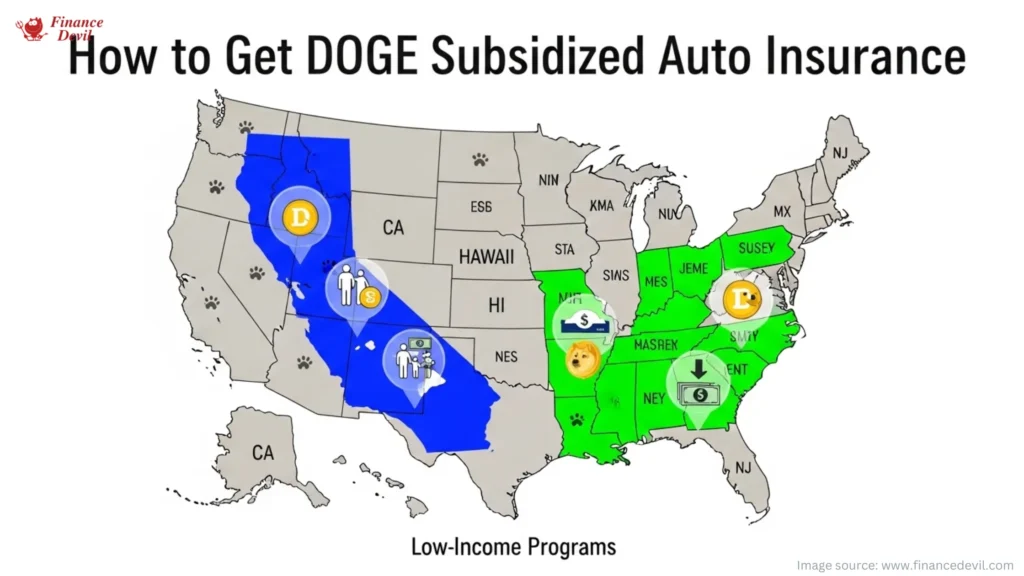
However, DOGE’s mandate is reducing government spending, not subsidizing private industry like auto insurance. There is no DOGE auto insurance program, no DOGE insurance voucher, and no official plan to route these savings to drivers’ premiums.
Warning: The “DOGE Car Insurance” Scam Targeting American Drivers
Before going further, this needs to be said clearly: fraudsters are actively exploiting the DOGE name to scam American drivers out of money and personal information.
How the Scam Works
- Fake websites advertise “DOGE subsidized auto insurance” with unrealistically low premiums
- Scammers ask for payment in Dogecoin (the cryptocurrency), making transactions nearly impossible to trace or recover
- After payment, the scammer disappears, leaving the driver with no insurance and no recourse
- Some sites impersonate Dodge (the car brand) or mix Dogecoin branding to seem credible
Red Flags to Watch For
- Requests for payment in Dogecoin or any other cryptocurrency
- No verifiable license number, physical address, or regulated contact details
- Promises of “government-subsidized” premiums with no official documentation
- Websites with spelling errors, generic stock photos, or no customer reviews
Protect Yourself: Always verify an insurer is licensed in your state through your state’s Department of Insurance website. Real insurers accept credit cards, bank transfers, and checks, not cryptocurrency.
Why Is Car Insurance So Expensive in the USA Right Now?
Before exploring savings strategies, it helps to understand why rates have climbed so sharply. Since 2011, national average auto insurance premiums have increased by 29.6%, according to data from The Zebra’s analysis of over 73 million unique rates.
Most and Least Expensive States for Auto Insurance (2023)
| Most Expensive State | Monthly Avg | Cheapest State | Monthly Avg |
| Michigan | $211 | Ohio | $77 |
| Florida | $194 | New Hampshire | $80 |
| Louisiana | $192 | North Carolina | $84 |
| Rhode Island | $156 | Virginia | $86 |
| Kentucky | $154 | Vermont | $88 |
Key factors driving these increases include rising vehicle repair costs (especially for cars with advanced tech), more severe weather events, inflation, and increased litigation in certain states.
Real Ways to Save on Auto Insurance in the USA (No Scams, No Crypto)
While DOGE subsidized auto insurance is not a real program today, the savings opportunities below are. Some can reduce your annual premium by hundreds of dollars.
1. Compare Rates Online
This single step is the most powerful thing most drivers never do. Rates vary dramatically by insurer, sometimes by $1,000 or more annually for identical coverage. Use comparison tools to get multiple quotes in minutes.
Pro Tip: Rates change daily. Comparing quotes even once a year can uncover significant savings, especially if your credit score has improved or you have had no recent claims.
2. Raise Your Deductible
Raising your deductible from $500 to $1,000 saves an average of 13% on your total annual insurance rate. If you have a solid emergency fund, this is a straightforward way to reduce monthly costs.
3. Leverage Your Credit Score
Drivers with poor credit pay an average of 114% more for car insurance than those with exceptional credit. Improving your credit score from fair to good can literally cut your premium in half over time.
4. Bundle Policies
Bundling your auto insurance with a homeowners or renters policy from the same company saves 5-10% on car insurance. Renters, note that you may pay up to 7.3% more than homeowners if you do not bundle.
5. Consider Usage-Based (Telematics) Insurance
Drivers with telematics-based policies save about 3% on average, and safe drivers can qualify for larger discounts. UBI tracks your actual driving habits, rewarding low-mileage and careful drivers.
6. Watch for Overlooked Discounts
- Pay online or in full upfront: save up to 12% ($186/year on average)
- Married drivers save about 6% ($98/year)
- Active duty military: average 2.6% discount
- Reduce annual mileage below 7,500: save about 6%
- Maintain continuous coverage for 5+ years: save up to 9%
Auto Insurance Savings Strategies: Side-by-Side Comparison
| Strategy | Avg. Savings | Effort Level | Best For |
| Compare rates online | Up to $1,000+/yr | Low (15 min) | Everyone |
| Raise deductible ($500 to $1K) | ~13% | Low | Emergency fund holders |
| Improve credit score | Up to 114% savings | Medium (months) | Fair/poor credit drivers |
| Bundle home + auto | 5-10% | Low | Homeowners/renters |
| Telematics/UBI policy | ~3-10% | Low | Low-mileage safe drivers |
| Pay in full / online | ~12% ($186/yr) | Low | Budget planners |
Could DOGE Savings Ever Benefit American Drivers?
DOGE’s stated mission is eliminating waste and fraud from the federal budget, not redistributing savings to consumers. According to Forbes reporting from April 2025, Elon Musk told Trump’s cabinet he expected DOGE to find $150 billion in savings in fiscal year 2026, a figure significantly lower than the $1 trillion target he set months earlier.
As of January 2026, DOGE’s own website reports $215 billion in total estimated savings. The top contract cancellations include a $4 billion Department of Defense BIM contract and a $3.9 billion Air Force aircraft maintenance contract. Some of the largest grant cancellations targeted international health organizations and infrastructure programs.
Whether any portion of these savings reaches American consumers directly depends entirely on future Congressional and White House decisions about the federal budget. No mechanism currently exists to channel DOGE savings into auto insurance subsidies.
Bottom Line: DOGE savings are a federal budget story, not a consumer insurance story, at least for now. Drivers seeking relief need to act independently using the strategies in this article.
Common Mistakes to Avoid When Shopping for Auto Insurance
- Renewing automatically without comparing: loyalty rarely pays in insurance; companies reserve best rates for new customers
- Choosing minimum liability only: state minimums leave you exposed to large out-of-pocket costs after an accident
- Ignoring your credit score: it is one of the biggest rate factors in most states
- Falling for scam “DOGE” insurance ads: if it requires cryptocurrency payment, it is a scam
- Not disclosing discounts you qualify for: military, good student, defensive driving course credits are often not applied automatically
- Adding rideshare coverage if you drive for Uber or Lyft is essential; skipping it can void your policy. expect a 15% rate increase
Conclusion: Take Control of Your Car Insurance Costs Today
DOGE subsidized auto insurance as a government program does not exist in the USA today, and any website or ad promising otherwise is a scam. However, the frustration driving that search is very real: American drivers are paying more than ever, with national averages at $1,759 per year and climbing.
The good news is that the strategies in this guide are proven and available right now. Comparing rates alone can save hundreds annually. Layering in bundling discounts, credit improvements, and telematics programs can compound those savings significantly.
Rates change daily. The best time to compare your auto insurance options is right now.
Frequently Asked Questions About DOGE Subsidized Auto Insurance in the USA
Is DOGE subsidized auto insurance a real government program?
No. There is no official government program called DOGE subsidized auto insurance. The Department of Government Efficiency (DOGE) focuses on cutting federal spending, not subsidizing private auto insurance premiums for American drivers.
Can I pay for car insurance with Dogecoin in the USA?
No legitimate, licensed car insurance company in the USA currently accepts Dogecoin as payment. If an insurer asks for Dogecoin, it is almost certainly a scam. Real insurers accept credit cards, bank transfers, and checks.
How much does the average American pay for car insurance?
According to The Zebra’s analysis of over 73 million insurance rates, the average American pays $1,759 per year for auto insurance. Rates vary widely by state, ranging from $77/month in Ohio to $211/month in Michigan.
What is the fastest way to lower my car insurance premium?
Comparing quotes online is the single fastest and most impactful step. Studies show drivers can save $1,000 or more annually simply by switching to a more competitive insurer. Takes about 15 minutes.
Will DOGE savings ever reduce auto insurance costs for Americans?
Potentially, if Congress and the White House direct budget savings toward consumer relief programs. But as of early 2026, no such proposal exists. DOGE savings have gone toward reducing the federal deficit, not consumer subsidies.
How do I report a fake DOGE car insurance website?
Report it to the FTC at reportfraud.ftc.gov, your state’s Department of Insurance, and the Internet Crime Complaint Center (IC3) at ic3.gov. If you paid with cryptocurrency and were scammed, also contact your state attorney general’s office.
What states have the cheapest auto insurance?
The cheapest states for auto insurance in 2023 include Ohio ($77/month), New Hampshire ($80/month), North Carolina ($84/month), Virginia ($86/month), and Vermont ($88/month). The New England region overall averages $1,305 per year, making it the most affordable region nationally.
Sources: The Zebra Auto Insurance Industry Statistics (January 2026); DOGE.gov Wall of Receipts (January 2026); Forbes, ‘Elon Musk Says DOGE Will Produce Savings of $150 Billion in FY2026’ (April 2025); FTC Fraud Reporting.