


Why CURE Auto Insurance Could Save You Hundreds (Or Cost You More)
If you’ve been turned down for affordable car insurance because of bad credit, CURE Auto Insurance might sound like a lifeline. This New Jersey-based insurer proudly advertises that it doesn’t consider your credit score, education level, or occupation when setting rates; only your driving record matters.
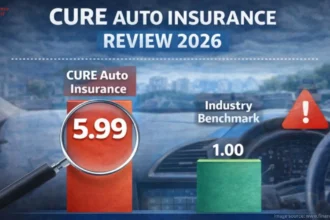
But here’s the catch: CURE receives nearly six times more customer complaints than the industry average, according to 2024 data from the National Association of Insurance Commissioners (NAIC). So is the potential savings worth the risk? This comprehensive CURE auto insurance review breaks down everything you need to know before getting a quote.
What Makes CURE (Citizens United Reciprocal Exchange) Different?
Founded in 1990 by former New Jersey Insurance Commissioner James J. Sheeran and Lena Chang, CURE Auto Insurance operates as a not-for-profit reciprocal exchange, meaning policyholders technically own the company, though a separate entity manages operations.
The Credit-Free Pricing Promise
Unlike the 95% of insurers that use credit-based insurance scores, CURE’s pricing model focuses on:
- Driving history (accidents, violations, years of experience)
- Age and gender (still considered despite criticism)
- Vehicle type and usage
- Location and parking situation
What they DON’T consider:
- Credit score
- Education level
- Occupation
- Homeownership status
This approach can benefit drivers with credit challenges, but it doesn’t guarantee the lowest rates for everyone.
CURE Auto Insurance Coverage Options: The Basics Only
CURE keeps things simple, perhaps too simple for drivers seeking comprehensive protection.
Standard Coverage Offerings
| Coverage Type | What’s Included | Notes |
| Bodily Injury Liability | $15K-$250K per person / $30K-$500K per accident | Required in NJ & PA |
| Property Damage Liability | $5K-$100K per accident | Minimum varies by state |
| Collision Coverage | 3 levels: Broad, Standard, Limited | Unique tiered approach |
| Comprehensive Coverage | Standard deductibles available | Glass repair network included |
| Personal Injury Protection (PIP) | $15K-$250K (required in NJ & MI) | No-fault coverage |
| Uninsured/Underinsured Motorist | Matches liability limits | Optional in some states |
| Roadside Assistance | Included in all policies | 24/7 service: 866-522-1991 |
The Unique Collision Coverage Tiers
CURE offers three collision options that other insurers don’t:
- Broad Collision – Deductible only applies if you’re more than 50% at fault
- Standard Collision – Traditional deductible always applies
- Limited Collision – Only pays if you’re less than 50% at fault (lowest cost)
This flexibility can help budget-conscious drivers customize protection, but determining fault percentages can complicate claims.
What’s Missing?
- Rental car reimbursement (only “extended transportation” available)
- Gap insurance
- New car replacement
- Accident forgiveness programs
- Rideshare coverage
If you need specialized coverage, you’ll likely need a supplemental policy elsewhere.
CURE Auto Insurance Rates: Who Gets the Best Deal?
Average Cost Comparison
CURE doesn’t publish average premium data, but our analysis of competitor rates in their three states shows:
| State | Average Full Coverage (All Insurers) | Average Minimum Coverage (All Insurers) |
| Michigan | $3,204/year ($267/month) | $900/year ($75/month) |
| New Jersey | $3,252/year ($271/month) | $1,416/year ($118/month) |
| Pennsylvania | $2,472/year ($206/month) | $540/year ($45/month) |
Who Saves Money with CURE?
Based on customer reviews and comparison data, these driver profiles typically find CURE competitive:
- Drivers with poor credit scores (600 or below)
- Young female drivers (ages 20-30)
- Drivers with clean records but non-traditional jobs
- Those who can qualify for multiple discounts
Who Pays More?
- Married couples (often 2-3x higher than competitors)
- Male drivers under 30 (50-60% more expensive)
- Drivers seeking maximum coverage (limited options inflate costs)
- Those with recent accidents (no accident forgiveness)
Real Example: A 30-year-old married couple in New Jersey might pay $2,541/year with CURE versus $993/year with GEICO, a difference of $1,548 annually.
CURE Auto Insurance Discounts: Limited But Valuable
CURE offers fewer discounts than national carriers, but they can add up:
| Discount | Potential Savings | Requirements |
| 3-Year Good Driver | Up to 35% | No accidents/violations for 36 months |
| 5-Year Good Driver | Up to 40% | Clean record for 60 months |
| Multi-Vehicle | Varies | 2+ vehicles on one policy |
| Off-Street Parking | Up to 15% | Driveway parking for comp/collision |
| Garage Parking | Up to 50% | Secured garage parking |
| Good Student | Varies | High grades (contact for details) |
| Low Mileage | Varies | Occasional use only |
Missing Discounts
Unlike State Farm, Progressive, or GEICO, CURE doesn’t offer:
- Bundling discounts (they only sell auto insurance)
- Defensive driving course discounts
- Paperless/automatic payment discounts
- Loyalty discounts
- Professional association discounts
The Complaint Problem: CURE’s Biggest Red Flag
By the Numbers
CURE’s 2024 NAIC complaint index of 5.99 means it receives nearly six times more complaints than expected for an insurer of its size. This has been consistent:
- 2024: 5.99 (vs. 1.00 benchmark)
- 2023: 4.37
- 2022: 2.29 (lowest in three years, still above average)
What Customers Complain About
According to BBB and Reddit reviews, common issues include:
Claims Processing Problems:
- Long wait times for adjuster assignment
- Delayed claim responses
- Difficulty reaching claims department
Customer Service Issues:
- Phone holds lasting 4-5 hours
- Unanswered calls and unreturned messages
- Limited service hours (Mon-Fri 8am-7pm, Sat 9:30am-4pm)
Billing and Policy Management:
- Refund processing delays
- Confusion about coverage levels
- Documentation disputes
Positive Feedback: Many customers with no claims experience praise CURE’s low rates and friendly service when adding vehicles or making policy changes.
CURE Auto Insurance Customer Reviews: The Real Story
What Customers Say (Verified Reviews)
Positive Reviews (Google: 3.6/5 | Consumer Affairs: 3.7/5)
“They have been phenomenal as far as customer service, anytime I have added a vehicle or had any kind of inquiry, they have been super friendly and timely. They also have the absolute cheapest rates out of any insurance company that I have asked for quotes from!” — Reddit User, August 2023
“Thank you, CURE Auto Insurance! My mother recommended this service after my uncle and sister had started a policy, and my rate is VERY affordable!” — Verified Customer Review
Negative Reviews (Clearsurance: 2.6/5 | BBB: 2.0/5)
“CURE does not pick up their phone, never responded to my car accident, my lawyers are handling it and they lied about me reporting the accident, thank God I have all my documents and screenshot the incident report online.” — Reddit User, November 2024
“They were supposed to give us a refund of a certain amount after cancelling the policy with them. But when we called customer service, they kept us waiting for 4-5 hours.” — BBB Review
Aggregate Rating: 2.97/5 (across 2,968 reviews)
The pattern is clear: Customers love CURE’s rates until they need to file a claim or get customer support.
How CURE Compares to Major Competitors
CURE vs. State Farm vs. Progressive
| Feature | CURE | State Farm | Progressive |
| States Available | 3 (MI, NJ, PA) | 50 states | 50 states |
| Avg. Full Coverage Cost | N/A | $2,711/year | $2,214/year |
| J.D. Power Score | Not rated | 710/1000 | 672/1000 |
| AM Best Rating | Not rated | A++ (Superior) | A+ (Superior) |
| Credit Score Used? | No | Yes | Yes |
| Bundling Options | None | Home, life, banking | Home, renters, life |
| Claims Process | Phone only 24/7 | Agent, phone, app | Phone, app, online |
| Customer Complaints (NAIC) | 5.99 | 0.43 | 0.58 |
The Verdict: CURE offers a unique no-credit-check option but lacks the financial ratings, coverage options, and customer satisfaction scores of established competitors.
Filing a CURE Auto Insurance Claim: What to Expect
Claim Filing Options
Unlike most insurers with multiple digital options, CURE keeps it old-school:
Phone: 800-229-9151 (24/7)
Online: cure.com/claims (report only, limited info required)
Mobile App: Available for iOS and Android
The Claims Process
- Report immediately after an accident (delays can complicate processing)
- Gather information: Date, time, location, other driver details, photos
- Wait for adjuster assignment (customers report this can take days)
- Track claim status through your online account
- Receive payment (timing varies widely based on reviews)
Red Flags from Customer Experiences
- Some policyholders report never being assigned an adjuster
- Phone wait times during business hours can exceed 4 hours
- Documentation disputes are common
- Fault determination for tiered collision coverage can be contentious
How to Buy CURE Auto Insurance (And Save Money)
Step 1: Check Availability
CURE only operates in:
- Michigan (since July 2021)
- New Jersey (since 1990)
- Pennsylvania (since early 1990s)
Step 2: Get a Quote
Phone: 800-535-2873
- Press 1 for Michigan
- Press 2 for New Jersey
- Press 3 for Pennsylvania
Online: Visit cure.com (limited instant quoting)
Step 3: Compare Aggressively
Given CURE’s complaint issues, get at least 3-4 quotes:
- GEICO (strong in PA and MI)
- State Farm (best customer service)
- Progressive (high-risk specialist)
- Erie Insurance (excellent in PA)
Step 4: Maximize Discounts
- Park off-street or in a garage (up to 50% savings)
- Maintain a clean driving record for 3+ years
- Insure multiple vehicles under one policy
- Consider usage-based insurance from competitors if mileage is low
Step 5: Choose the Right Collision Tier
- Broad Collision: Best if you drive in high-traffic areas
- Standard Collision: Most common choice
- Limited Collision: Only if you’re an excellent defensive driver
Payment Options and Fees (Watch Out for Extra Costs)
| Payment Method | Convenience Fee | Best For |
| Auto-Pay (Bank) | $0 | Saving the most money |
| Phone Payment | Varies | One-time payments |
| Online Payment | $14.95 | Avoid if possible |
| Text-to-Pay | $5.99 | Quick payments on the go |
| Mail (Check) | $0 | Traditional option |
Pro Tip: The $14.95 online payment fee adds up to $179.40 per year if paying monthly. Set up auto-pay from your checking account to avoid this.
5 Mistakes to Avoid with CURE Auto Insurance
1. Choosing CURE Based Only on Low Rates
If you’re in an accident, poor claims service can cost more than you saved in premiums.
2. Skipping Competitor Quotes
Many drivers assume CURE is cheapest for bad credit, but State Farm and Erie sometimes beat CURE for certain profiles.
3. Selecting Limited Collision Without Understanding It
This tier only pays if you’re less than 50% at fault; fault disputes can leave you with no coverage.
4. Paying Online Monthly
The $14.95 monthly fee makes this the most expensive payment option over a year.
5. Assuming All States Have the Same Coverage
Michigan’s no-fault laws, New Jersey’s PIP requirements, and Pennsylvania’s tort options mean your policy varies significantly by state.
CURE Auto Insurance: Financial Strength and Stability
The Rating Gap
AM Best Rating: Not rated
Why It Matters: AM Best assesses insurers’ ability to pay claims. Without a rating, consumers can’t independently verify CURE’s financial stability.
J.D. Power Score: Not rated (too small to be included)
Why It Matters: J.D. Power measures customer satisfaction. CURE’s absence means no third-party validation of service quality.
BBB Rating: A+ (based on business practices, not customer experience)
What This Means for You
While CURE has operated since 1990 without major financial issues, the lack of independent ratings means you’re trusting:
- The company’s self-reported financial data
- State insurance department oversight (minimal)
- The reciprocal exchange structure (theoretically member-focused)
For comparison, State Farm holds an A++ rating (highest possible) and Progressive maintains an A+ (second-highest).
Frequently Asked Questions About CURE Auto Insurance
Is CURE Auto Insurance legitimate?
Yes, CURE is a licensed insurer operating since 1990 in Michigan, New Jersey, and Pennsylvania. However, its high complaint ratio (5.99 vs. 1.00 benchmark) raises service quality concerns.
Does CURE really not check credit scores?
Correct. CURE does not use credit-based insurance scores when calculating premiums, focusing primarily on driving history instead. However, they still consider age and gender.
Why are CURE’s rates higher for married couples?
CURE’s pricing algorithm doesn’t offer the typical “married discount” that other insurers provide. Their model weighs individual risk factors differently, often resulting in higher rates for multi-driver households.
How long does CURE take to process claims?
Customer reviews indicate wide variation from a few days to several weeks. The biggest complaints involve delayed adjuster assignments and difficulty reaching the claims department.
Can I bundle CURE with home insurance?
No. CURE only offers auto insurance. For bundling discounts, consider State Farm (average 17% savings) or Progressive (average 12% savings).
What happens if I move out of MI, NJ, or PA?
You’ll need to find a new insurer, as CURE doesn’t operate in any other states. Most insurers allow policy transfers if you move, but CURE cannot accommodate this.
Is CURE good for high-risk drivers?
It depends. Drivers with poor credit but clean driving records benefit most. Those with accidents or violations may find better rates with Progressive or The General, which specialize in high-risk coverage.
How do I cancel my CURE policy?
Call 800-535-2873 during business hours (Mon-Fri 8am-7pm, Sat 9:30am-4pm). Customer reviews suggest getting written confirmation of cancellation and refund amounts.
Does CURE offer gap insurance?
No. CURE doesn’t provide gap insurance, which covers the difference between your car’s value and your loan balance after a total loss. You’ll need to purchase this through your lender or another insurer.
Can I file a CURE claim online?
You can report a claim online at cure.com/claims, but the full claims process requires phone communication. The mobile app offers limited claims tracking only.
Expert Tips: Getting the Most Value from CURE
If You Have Bad Credit
- Get quotes from 5+ insurers – CURE, Dairyland, Bristol West, The General, and Progressive
- Emphasize your driving record – Clean history is your best negotiating tool
- Ask about payment plans – Avoid the $14.95 online fee by setting up auto-pay
If You’re Choosing CURE
- Document everything – Based on complaint patterns, keep records of all communications
- Test customer service before buying – Call during business hours to gauge wait times
- Read your policy carefully – Understand which collision tier you’re selecting
- Set up auto-pay immediately – Avoid the $179.40/year in payment fees
- Keep competitor quotes – Re-shop every 6-12 months as your credit improves
If You’re Filing a Claim
- Report immediately – Don’t wait, even if damage seems minor
- Use online reporting first – Get a claim number immediately
- Follow up in writing – Email or message through the portal for documentation
- Be persistent – If you don’t hear back in 48 hours, call again
- Know your rights – Contact your state insurance department if claims drag on unreasonably
The Bottom Line: Should You Choose CURE Auto Insurance?
CURE Makes Sense If You:
- Live in Michigan, New Jersey, or Pennsylvania
- Have poor credit but a clean driving record
- Are a young female driver
- Don’t need specialized coverage
- Park in a garage (50% discount potential)
- Rarely need customer service
- Can shop around and confirm CURE is truly cheapest
Skip CURE If You:
- Need reliable claims service and customer support
- Want to bundle multiple policies
- Are married or have multiple drivers
- Have had recent accidents or violations
- Need specialized coverage (rideshare, gap insurance, etc.)
- Value financial strength ratings
- Want digital-first service options
The Final Verdict
CURE Auto Insurance fills a unique niche for drivers with poor credit in three states. The no-credit-check model can deliver genuine savings for the right profile. However, the 5.99 complaint ratio is impossible to ignore; you’re accepting significant service risk to access those savings.
Best approach: Get a CURE quote, then compare it against at least three competitors. If CURE beats them by less than 15%, the customer service risk likely isn’t worth it. If CURE saves you 30%+ annually, it may be worth trying, but keep shopping every six months as your credit improves.
Remember: Car insurance rates change daily. The market shifts, your risk profile evolves, and new discounts emerge. Lock in savings today, but never stop comparing.
Take Action: Compare CURE and Top Competitors Today
Auto insurance rates in Michigan, New Jersey, and Pennsylvania can vary by $2,000+ per year between insurers for the same driver. Don’t leave money on the table.
Next Steps:
- Check your credit score – Know where you stand before getting quotes
- Gather your information – Driver’s license, VIN, current policy (if applicable)
- Get 4-5 quotes minimum – Include CURE, State Farm, Progressive, GEICO, and a local insurer
- Compare total cost – Factor in payment fees and coverage differences
- Read recent reviews – Check BBB and Reddit for current customer experiences
- Ask about discounts – Especially parking, multi-vehicle, and good driver discounts
Insurance companies update rates constantly. What’s expensive today might be competitive next month and vice versa. Compare quotes every 6-12 months to ensure you’re getting the best deal for your specific situation.
Need help comparing? Contact licensed agents who can quote multiple insurers simultaneously and find the best coverage for your unique needs.
Disclaimer: This article provides general information about CURE Auto Insurance. Rates, coverage options, and availability vary by state and individual circumstances. Always request personalized quotes and read policy documents carefully before purchasing insurance. The author is not affiliated with CURE Auto Insurance or any insurance company mentioned in this article.
Last Updated: January 2026