



Your home has likely appreciated considerably over the past few years. If you have been watching that equity grow and wondering how to put it to work, you are not alone. According to data from Cotality, mortgage-holding U.S. homeowners carried an average of around $307,000 in tappable equity as of mid-2025, making it one of the largest financial assets most Americans own.
Two of the most popular ways to access that equity are a cash-out refinance and a Home Equity Line of Credit (HELOC). Both let you convert equity into usable cash, but they work very differently and, depending on your situation, one can cost you significantly more than the other.
This article breaks down exactly how each option works, what the real numbers look like in today’s market, and the specific scenarios where one clearly wins over the other.
How Each Option Works
Cash-Out Refinance: Replace Your Mortgage, Get Cash
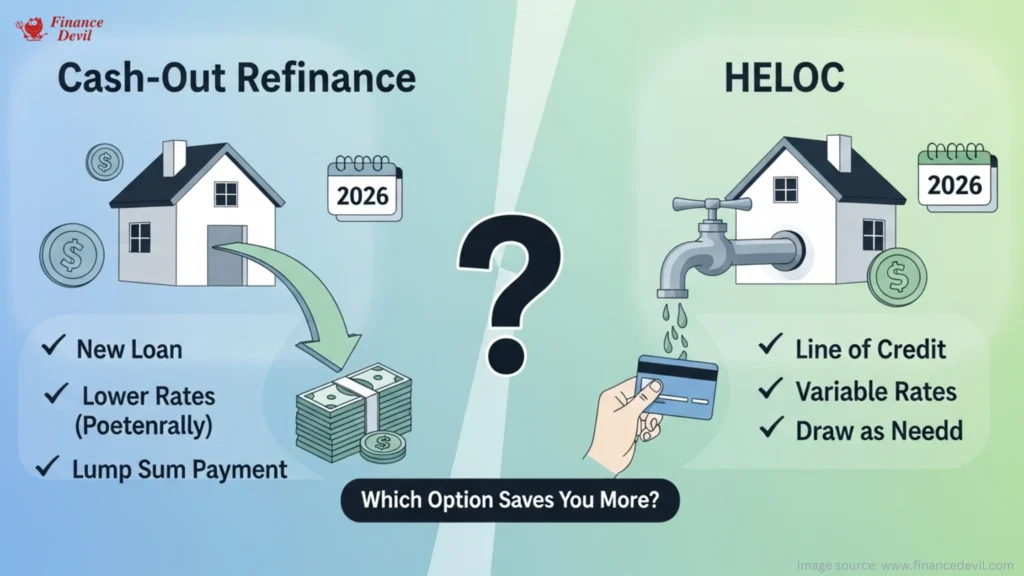
A cash-out refinance replaces your existing mortgage with a new, larger loan. You receive the difference between the new loan amount and your old balance as a lump sum at closing. Your old mortgage is paid off entirely, and you are left with one new loan under new terms.
For example, if your home is worth $450,000 and you owe $280,000, a lender may allow you to refinance up to 80% of the home’s value ($360,000). After paying off your existing mortgage, you would receive $80,000 in cash. You would then make monthly payments on the full $360,000 at the new loan’s interest rate.
Most cash-out refinances come with fixed interest rates, meaning your payment stays the same for the life of the loan. Closing costs typically range from 2% to 6% of the total loan amount, which on a $300,000 refinance could mean $6,000 to $18,000 in upfront fees.
HELOC: Keep Your Mortgage, Open a Credit Line
A HELOC is a second mortgage that sits on top of your existing home loan without touching it. Instead of receiving one lump sum, you get access to a revolving credit line that you can draw from during a set period, typically 10 years. You only pay interest on what you actually borrow.
After the draw period ends, you enter a repayment phase of 10 to 20 years during which you pay back both principal and interest. HELOC rates are variable, meaning they move with the prime rate, which is directly influenced by Federal Reserve policy.
Upfront costs for a HELOC are considerably lower, often ranging from $0 to $500, and many lenders offer no-closing-cost options. (Bank of America, 2026)
| Key distinction: A cash-out refinance replaces your mortgage. A HELOC adds a new loan on top of it. This single difference drives most of the other distinctions between the two products. |
Rate and Cost Comparison in 2026
The rate environment heading into 2026 looks meaningfully different from a year ago. The Federal Reserve cut its benchmark rate three times in late 2025 (September, October, and December), bringing borrowing costs down for both products. Here is where things stand today:
Cash-Out Refinance Rates
Cash-out refinance rates are essentially mortgage rates and tend to track the 30-year fixed market closely. As of early 2026, 30-year fixed cash-out refinance rates range from approximately 6.8% to 8.5% APR depending on credit score, loan-to-value ratio, and lender. The most competitive lenders are quoting rates from around 6.25% for borrowers with excellent credit and low LTV.
Because cash-out refinances are primary mortgages, lenders view them as lower risk than HELOCs, which generally allows for lower interest rates.
HELOC Rates
HELOC rates are variable and tied to the prime rate, which currently sits at 7.5% (Wall Street Journal, March 2026). HELOCs are typically priced at 0.5% to 1% above prime, putting most borrowers in the 8.0% to 8.5% APR range. Borrowers with excellent credit and strong equity may access rates closer to the lower end of that range.
It is worth noting that while cash-out refinances offer lower rates on paper, HELOCs often come out cheaper in total cost when you factor in the lack of closing costs, especially for smaller borrowing amounts.
A Real-World Cost Comparison
Consider this scenario: a homeowner wants to borrow $60,000 against their home equity.
- Cash-Out Refinance: New loan of $340,000 at 7.0% fixed for 30 years. Closing costs: approximately $8,000 to $10,000. Monthly payment increases significantly because the entire mortgage is being refinanced.
- HELOC: $60,000 credit line at 8.25% variable. Closing costs: near zero. Monthly interest-only payment during draw period: approximately $412.
The cash-out refinance carries a lower rate on the borrowed amount, but the closing costs and the reset of the full mortgage term can easily offset that advantage, particularly if the homeowner does not plan to stay in the home long-term.
| Feature | Cash-Out Refi | HELOC | Best For |
| Structure | Replaces mortgage | Second lien (revolving) | Depends on situation |
| Rate Type | Fixed (usually) | Variable (tied to prime) | Fixed-rate preference |
| 2026 Avg. Rate | ~6.8% – 7.5% APR | ~8.0% – 8.5% APR | Lower rate: Cash-out refi |
| Closing Costs | 2% – 6% of loan | $0 – $500 typically | Low upfront: HELOC |
| Funds Disbursed | Lump sum at closing | Draw as needed | Ongoing needs: HELOC |
| Affects Mortgage? | Yes – replaces it | No – separate loan | Low-rate holders: HELOC |
| Max LTV | 80% (some up to 90%) | 85% CLTV | More equity: HELOC |
| Tax Deductible? | Only for home use | Only for home use | Consult a tax pro |
| Timeline to Fund | 21 – 45 days | 2 – 4 weeks | Faster: HELOC |
Rates as of March 2026. Sources: The Mortgage Reports, WiseIQ, CBS News. Rates vary by lender, credit profile, and LTV.
READ ALSO: How to Use a HELOC Calculator to Find Your Best Rate
The Most Important Factor: Your Existing Mortgage Rate
Of all the variables that determine which option is right for you, your current mortgage rate is by far the most important. This one factor can make the cash-out refinance either very attractive or financially damaging.
Chase Home Lending’s Bhavesh Patel put it directly: “If a homeowner is sitting at a lower rate, a HELOC might be a better option because it allows you to borrow against your home’s equity without changing the terms of your existing mortgage.” (CBS News, December 2025)
If Your Mortgage Rate Is Below 5%
Millions of homeowners locked in rates between 2.5% and 4% during 2020 and 2021. Replacing that mortgage with a new one at today’s rates of 6.8% or higher would dramatically increase your monthly payment on the full mortgage balance, not just the equity you are pulling out.
For these homeowners, a HELOC is almost always the smarter choice. You access the equity you need while keeping your ultra-low first mortgage intact. As a rule of thumb, mortgage-info.com notes that if your current rate is below 5%, a HELOC is typically the better path.
If Your Mortgage Rate Is Above 6.5%
If you are carrying a rate of 6.5% or higher on your existing mortgage, a cash-out refinance becomes much more compelling. You may be able to secure a new rate close to or even lower than what you currently pay, while also pulling out cash. In this scenario, you get two benefits in one transaction.
The break-even question to ask: will you stay in the home long enough to recoup the closing costs through monthly savings? If yes, a cash-out refinance can make a lot of financial sense.
Pros and Cons Side by Side
Cash-Out Refinance: Pros
- Fixed, predictable payments for the life of the loan, making budgeting easier
- Lower interest rate than a HELOC in most market conditions since it is a primary mortgage
- Single consolidated payment for your entire mortgage, eliminating the need to manage multiple loans
- Potentially lower rate and access to more equity for borrowers with higher current rates
- Ideal for large, one-time expenses where you know exactly how much you need upfront
Cash-Out Refinance: Cons
- High closing costs: 2% to 6% of the loan amount, which can easily reach $10,000 to $20,000
- Resets your mortgage clock: if you are 10 years into a 30-year loan, you start over with a new 30-year term
- Dangerous if your rate is low: trading a 3% mortgage for a 7% mortgage to get cash is rarely a good deal
- Full underwriting process required, including appraisal, income verification, and credit check
- 21 to 45 days to close, which may be too slow for urgent funding needs
HELOC: Pros
- Low to no closing costs: many lenders offer HELOCs with minimal or waived upfront fees
- Preserves your existing mortgage: your first mortgage rate stays untouched
- Flexible access to funds: draw only what you need, when you need it, and only pay interest on that amount
- Interest-only payments during draw period keep monthly costs low initially
- Reusable credit line: once repaid, you can draw from it again during the draw period
HELOC: Cons
- Variable interest rate: if the Fed raises rates, your payments rise with them
- Payment shock at repayment: monthly payments increase significantly once the draw period ends
- Lender can reduce or freeze your line if your home’s value drops or your financial situation changes
- Higher rate than cash-out refinances in most market environments
- Requires discipline: revolving access to credit can lead to overborrowing
Which Is Right for Your Situation? A Scenario Guide
There is no universal answer. The right choice depends on your existing rate, how much you need, how you plan to use it, and how comfortable you are with rate variability. Use this guide to quickly identify which product fits your situation.
| Your Situation | Better Option |
| Your mortgage rate is below 5% | HELOC – preserve that rate |
| Your mortgage rate is above 6.5% | Cash-Out Refinance – could lower it too |
| You need funds in phases (e.g. renovation) | HELOC – draw as needed |
| You need one large lump sum | Cash-Out Refinance |
| You want predictable fixed payments | Cash-Out Refinance |
| You want low upfront costs | HELOC |
| You want to consolidate all debt into one payment | Cash-Out Refinance |
| You may only need part of the available funds | HELOC – only pay for what you use |
What 2026 Market Conditions Mean for This Decision
The broader rate environment plays a big role in this comparison, and 2026 presents a specific set of conditions that are worth understanding before you commit to either option.
Andy Walden, head of mortgage and housing market research at Intercontinental Exchange, observed that recent refinance activity has “primarily centered on borrowers aiming to lower their monthly payments rather than extract equity,” while also noting a “modest uptick in cash-out refinances.” (CBS News, December 2025)
What this tells us: cash-out refinancing makes sense primarily when refinancing would also reduce your monthly payment. If the only reason you are refinancing is to pull equity, a HELOC is likely the more efficient path in 2026’s rate environment.
Rate Trajectory and HELOC Risk
Because HELOCs carry variable rates, they carry rate risk. The Fed signaled it may pause further cuts heading into 2026, meaning HELOC rates are unlikely to fall dramatically in the near term but are also unlikely to spike. For most borrowers, this creates a relatively stable short-term environment for HELOC borrowing.
However, if economic conditions shift and the Fed pivots back to rate hikes, HELOC holders would feel that immediately in their monthly payments. A cash-out refinance at a fixed rate eliminates that risk entirely.
The Equity Landscape
U.S. homeowners collectively hold an estimated $17.5 trillion in home equity as of mid-2025, per Cotality data. That unprecedented level of equity means lenders are actively competing for borrowers in both the cash-out refinance and HELOC markets, which benefits consumers through competitive rates and terms. Shopping multiple lenders remains one of the single most effective ways to reduce the overall cost of either product.
Research from Freddie Mac found that borrowers who obtained at least four rate quotes potentially saved over $1,200 per year on a refinance. (Fortune, 2025)
Tax Implications: What You Need to Know
Both cash-out refinances and HELOCs can offer tax advantages, but only under specific conditions.
The IRS allows homeowners to deduct interest on home equity debt only when the funds are used to buy, build, or substantially improve the home securing the loan. Interest on amounts used for debt consolidation, vacation expenses, or other non-home purposes is not deductible. (WiseIQ, 2026)
This rule applies equally to both products. Always consult a qualified tax professional before assuming deductibility, as your specific situation, including how funds are used, will determine eligibility.
The Bottom Line
Both cash-out refinances and HELOCs are legitimate, powerful tools for tapping home equity. Neither is categorically better than the other. The right answer depends almost entirely on where your current mortgage rate sits relative to today’s market rates, how you plan to use the funds, and how much you value predictability versus flexibility.
| Choose a Cash-Out Refinance if: Your existing rate is 6.5% or higher, you need a large lump sum, you want fixed predictable payments, or you want to consolidate all debt into one mortgage payment.Choose a HELOC if: Your existing mortgage rate is below 5%, you need flexible ongoing access to funds, you want to keep upfront costs low, or you only need to borrow a portion of your available equity.When in doubt: Run the math with actual lender quotes. The break-even point on closing costs is often the deciding factor for homeowners who are on the fence. |
Shopping multiple lenders for both products before making a decision is always a smart move. Rates, fees, and terms vary significantly from lender to lender, and comparing at least three to four quotes can translate into thousands of dollars in savings over the life of whichever product you choose.
This article is for informational purposes only and does not constitute financial or tax advice. Consult a qualified financial advisor or tax professional before making borrowing decisions.
Sources
CBS News: HELOCs vs. Cash-Out Refinancing in 2026
The Mortgage Reports: HELOC vs. Cash-Out Refinance
WiseIQ: HELOC vs. Cash-Out Refinance Guide 2026
Bank of America: Cash-Out Refinance vs. HELOC
Rocket Mortgage: HELOC vs. Cash-Out Refinance
The Mortgage Reports: Refinance Closing Costs