




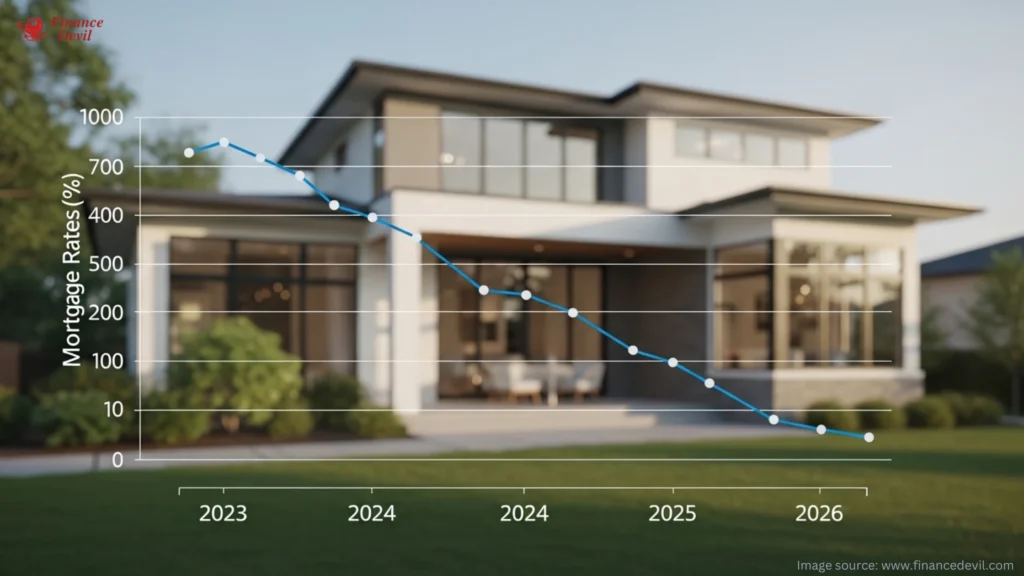
If you locked in a mortgage during the rate surge of 2023 or 2024, you already know the sting of a 7%-plus interest rate on a monthly statement. The good news is that 2026 is shaping up to be a meaningfully different environment. Rates have been falling, slowly but steadily, and for millions of American homeowners, that shift is opening a real conversation about refinancing.
But “rates are dropping” is not a plan. Understanding why they are dropping, how far they are likely to go, and whether refinancing actually makes sense for your situation is where the real value lies. This guide breaks all of that down.
Where Mortgage Rates Stand Right Now
As of March 26, 2026, the 30-year fixed mortgage rate averages 6.38%, according to Freddie Mac’s Primary Mortgage Market Survey. That is up slightly from 6.22% the prior week, but still well below the 6.65% average recorded a year earlier.
The 15-year fixed-rate mortgage currently averages 5.75%, and the average 30-year fixed refinance rate sits at approximately 6.66%, per Bankrate’s latest national data.
| Loan Type | Current Rate (March 2026) | 1 Year Ago |
| 30-Year Fixed (Purchase) | 6.38% | 6.65% |
| 15-Year Fixed (Purchase) | 5.75% | 5.89% |
| 30-Year Fixed (Refinance) | ~6.66% | ~7.10%+ |
| 5/1 ARM | ~5.68% | ~6.30% |
Sources: Freddie Mac PMMS, March 26, 2026; Bankrate, March 2026
What Is Driving Mortgage Rates Lower in 2026
Mortgage rates do not move in isolation. Several interconnected forces have been nudging them downward over the past several months, and understanding these drivers helps predict where things go from here.
The Federal Reserve’s Rate Cuts
The Fed ended 2025 with three consecutive rate cuts and signaled the possibility of more reductions in 2026. While the central bank does not set mortgage rates directly, its policies shape market expectations and influence the 10-year Treasury yield, which is the closest proxy for long-term mortgage pricing.
However, the Fed pressed pause at its January 2026 meeting, citing inflation concerns tied to new tariff policy and geopolitical uncertainty. It held again in March. As a result, the gradual decline in rates has slowed somewhat, creating a market watching every CPI report for signals about the next move.
Inflation Slowly Cooling
Inflation has eased considerably from its 2022 peak, moving closer to the Fed’s 2% target. When inflation falls, the fixed-income market relaxes, bond yields slip, and mortgage rates typically follow. This dynamic has been the single biggest driver of the improvement homeowners have seen since mid-2025.
Treasury Yield Dynamics
The Congressional Budget Office projects that the 10-year Treasury yield will reach approximately 4.1% by the end of 2026. With the typical spread between the 10-year Treasury and a 30-year mortgage running around 2.0 to 2.5 percentage points, that projection supports a mortgage rate landscape in the mid-to-upper 6% range through the rest of the year.
The Government’s Mortgage-Backed Securities Purchase
In a notable market intervention, the federal government moved to purchase $200 billion in mortgage-backed securities (MBS) in early 2026, aimed at increasing demand for mortgage bonds and nudging borrowing costs lower. While this contributed to a dip in rates and a pickup in refinance activity, most experts caution that its long-term impact is modest relative to broader economic forces.
What Experts Are Forecasting for the Rest of 2026
Here is what major institutions and forecasters expect for mortgage rates through the remainder of this year:
| Institution | Rate Projection | Notes |
| Fannie Mae | 5.9% by year-end | Inflation-dependent |
| Bankrate | ~6.1% average; 5.7%-6.5% range | Volatile swings possible |
| Mortgage Bankers Assoc. (MBA) | 6.4% in Q1-Q2 2026 | Slow, steady decline |
| Jeff DerGurahian, loanDepot CIO | ~5.5% by midyear (if inflation cools) | Optimistic scenario |
| Freddie Mac | Rates below 2025 levels all year | Gradual improvement |
Sources: Fannie Mae October 2025 Economic and Housing Outlook; Bankrate Mortgage Forecast 2026; U.S. News, February 2026
What no one is forecasting: a return to the 3% rates of 2020 and 2021. Those rates were tied to emergency pandemic-era monetary policy. According to Freddie Mac data going back to 1971, the average 30-year fixed rate has been around 7.8%, making today’s rates relatively modest from a historical perspective.
Who Should Seriously Consider Refinancing in 2026
About 21% of mortgaged American homeowners are currently carrying a loan with a 6% rate or higher, according to Federal Housing Finance Agency data. For many of them, the current environment represents a window worth examining, even if today’s rates have not dropped dramatically below where they borrowed.
Strong Candidates for Refinancing
- Homeowners who locked in at 7% or higher in 2023-2024. Even moving from 7.5% to 6.38% on a $350,000 mortgage reduces monthly principal and interest by roughly $300 or more, generating meaningful annual savings.
- Those planning to stay in their home for five or more years. The longer the timeline, the more likely you will surpass your refinance break-even point and come out ahead.
- Borrowers on adjustable-rate mortgages (ARMs). If your ARM is approaching its first adjustment and rates have not fallen as hoped, switching to a 30-year fixed can eliminate payment uncertainty.
- Homeowners who want to shorten their loan term. Refinancing a 30-year loan to a 15-year can dramatically cut total interest paid, even if the monthly payment rises slightly.
- Those with high-rate FHA loans. Refinancing into a conventional loan can also eliminate mortgage insurance premiums if your home equity has reached 20%.
Who Should Probably Wait
- Homeowners with a rate below 4% from 2020 or 2021. Refinancing now would cost you more than you save.
- Those planning to sell within two to three years. You may not reach your break-even point in time.
- Borrowers with significantly damaged credit since their original loan. Rebuilding your score first typically yields a better rate offer.
The Break-Even Point: The Number That Actually Matters
Before you refinance, the most important question is not “What is the rate?” It is “When will I break even?” The break-even point is the number of months it takes for your monthly savings to fully recover the upfront cost of the new loan.
| How to Calculate Your Break-Even PointThe formula is straightforward: Total Closing Costs / Monthly Savings = Months to Break-Even Example: You refinance a $300,000 mortgage from 7.25% to 6.38%. Your monthly payment drops by $175. Closing costs are $5,000. Break-even: 5,000 / 175 = approx. 29 months (under 2.5 years). In 2026, many lenders prefer to see a break-even point of 36 months or less. If your math puts you well under that threshold and you are staying in the home, the case for refinancing is strong. |
Keep in mind that refinance closing costs typically run 2% to 6% of the outstanding loan balance. On a $250,000 balance, that is $5,000 to $15,000. If you would rather avoid a large upfront payment, ask about a no-closing-cost refinance, where costs are rolled into the loan or offset by a slightly higher rate.
Per NerdWallet, the average cost of a mortgage refinance is around $5,000, which means for most borrowers, the break-even window falls somewhere between 18 and 36 months at current savings rates.
How to Position Yourself for the Best Refinance Rate
Not every homeowner qualifies for the advertised average rate. Lenders reserve the lowest rates for borrowers who present the least risk. Here is how to make sure you are as competitive as possible when you apply.
1. Know Your Credit Score
Borrowers with scores above 780 consistently receive the best rate offers. If your score has slipped since your original mortgage, spending three to six months reducing balances and catching up on any late payments before applying can move you into a better rate tier. A score below 620 will make it difficult to qualify at all.
2. Check Your Home Equity
Lenders typically want to see at least 20% equity in your home. With home values remaining relatively stable in most U.S. markets despite slower growth, many homeowners who purchased three or more years ago have built meaningful equity through appreciation and loan paydown.
3. Lower Your Debt-to-Income Ratio
Most lenders want your total monthly debt payments, including the new mortgage, to stay below 43% to 45% of your gross monthly income. Paying down credit card balances before applying can push your DTI into a more favorable range and improve your rate offer.
4. Shop at Least Three Lenders
Rate differences between lenders can be significant. Comparing offers from at least three lenders, including your current servicer, a national bank, and a local credit union or mortgage broker, can surface meaningfully better terms. Even a 0.25% difference on a $350,000 loan represents thousands of dollars over the life of the loan.
5. Consider Locking Your Rate
Given the volatility in the market right now, locking your rate once you have a strong offer provides protection against upward swings while you complete the application process. Some lenders offer a float-down option, which allows you to capture a lower rate if market rates dip further before closing.
What the Rate Trend Means for Refinancing Activity Nationally
The improving rate environment is already translating into real activity. Real estate platform Redfin is forecasting that U.S. mortgage refinance volume may increase by more than 30% in 2026 compared to the previous year. Purchase and refinance applications are both up year-over-year, according to the latest Freddie Mac data.
That pickup in demand is a meaningful signal. When refinancing volume rises sharply, lenders get busier, processing times lengthen, and the most competitive rates can disappear faster. If refinancing makes sense for your numbers, waiting for a rate that is another 0.25% lower while paying a higher rate every month may cost more than you gain.
As Jeff DerGurahian, chief investment officer at loanDepot, put it: “If you are one of the millions of homeowners who purchased at the high rates of the last few years, you will likely find 2026 an attractive window to refinance.”
Key Risks to Watch in 2026
The rate outlook is broadly positive, but several factors could interrupt or reverse the downward trend:
- Inflation resurgence. If CPI data comes in hotter than expected in the coming months, the Fed could be forced to delay rate cuts or reverse course, which would push mortgage rates back up.
- Geopolitical shocks. Events that trigger a flight to safety in global markets often push Treasury yields up, dragging mortgage rates along with them.
- Federal Reserve leadership uncertainty. Changes in Fed leadership and philosophy can shift market expectations rapidly, as markets in early 2026 are already experiencing.
- Stubborn inflation from tariffs. New tariff policy has introduced fresh inflationary pressure, which the Fed is watching closely before committing to additional cuts.
The Bottom Line
Mortgage rates in 2026 are on a gradual downward path, with the 30-year fixed currently at 6.38% and most major forecasters projecting a range of 5.7% to 6.5% through the rest of the year. That is a real improvement from the 7%-plus environment of 2023 and 2024.
For homeowners who bought or refinanced at peak rates, this window is worth taking seriously. Run your break-even numbers, check your credit score, compare at least three lenders, and make the decision based on your personal timeline, not on predictions about where rates are heading.
Rates change week by week. The best time to refinance is not necessarily when rates hit their lowest point. It is when the math works for your situation, and for a meaningful portion of American homeowners right now, that math is beginning to add up.
Frequently Asked Questions
Are mortgage rates expected to drop further in 2026?
Most major forecasters, including Fannie Mae, Bankrate, and the Mortgage Bankers Association, project that rates will drift modestly lower through 2026, with a possible landing zone between 5.7% and 6.5%. However, that trajectory is not guaranteed. Inflation data, Fed policy decisions, and broader economic conditions could push rates in either direction.
How much do rates need to drop before refinancing is worth it?
The old rule of thumb was a full percentage point drop. In 2026’s market of larger loan balances, even a half-point reduction can generate meaningful monthly savings. What actually matters is your personal break-even point. Divide your estimated closing costs by your monthly savings to find out how many months it takes to recover those costs. If you plan to stay in the home beyond that point, refinancing is likely worth it.
What credit score do I need to refinance?
Most conventional lenders require a minimum score of 620, but to access the best advertised rates, you typically need a score of 780 or higher. FHA refinance programs may accommodate scores as low as 580 with certain lenders.
What are typical closing costs for a refinance?
Refinance closing costs generally run 2% to 6% of the outstanding loan balance. On a $300,000 mortgage, that means $6,000 to $18,000 in fees. If you prefer to avoid a large upfront expense, ask lenders about no-closing-cost refinances, where fees are rolled into the loan balance or offset by a slightly higher interest rate.
Should I refinance to a 15-year or 30-year mortgage?
It depends on your goals. A 15-year mortgage typically comes with a lower interest rate and dramatically reduces your total interest paid over the life of the loan, but your monthly payment will be higher. A 30-year refinance lowers your monthly payment, giving you more cash flow flexibility, but you pay more interest over time. If your income is stable and your primary goal is long-term wealth building, the 15-year option often wins mathematically.
Is it risky to refinance right now if rates might drop further?
Trying to perfectly time the market is notoriously difficult, even for professional investors. While rates may drop further, every month you spend at a higher rate costs you real money. If refinancing today clears your break-even threshold within two to three years and you plan to stay in the home, acting now rather than waiting may produce better outcomes than holding out for a rate that may or may not materialize.
Do I need a home appraisal to refinance?
In most cases, yes. Lenders typically require a new appraisal to confirm your home’s current value and calculate your loan-to-value ratio. However, some loan programs, such as VA Interest Rate Reduction Refinance Loans (IRRRLs) and FHA Streamline refinances, may waive the appraisal requirement under certain conditions.
This article is for informational purposes only and does not constitute financial or mortgage advice. Always consult a licensed mortgage professional before making refinancing decisions.
In another related article, Traceloans.com Mortgage Loans