Finance Devil has created several calculators to help an investor reach his or her financial goals. If you have a question or suggestion for a new calculator, send us an email and we will build a new calculator and display the formula used.
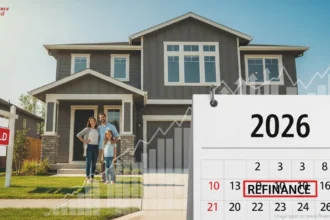
Millions of homeowners are overpaying on their mortgage every single month. Here are the seven clearest signals that your current loan is costing you more than it should and what to do about it.
Still, refinancing is not something to do just because rates moved. The decision needs to be grounded in your specific numbers, your loan type, your equity position, and your plans for the property. Below are the seven clearest signals that the math is working in your favor right now.
~1 in 5Borrowers carry a rate of 6%+ (Realtor.com)
132%YoY jump in refi applications, early 2026 (MBA)
30%+Projected rise in refinance volume 2026 (Redfin)
Sign 1Your Current Rate Is at Least 0.5% to 1% Higher Than What You Can Get Today
This is still the most fundamental trigger. If you locked in a mortgage at 7.5% or 8% during the 2023-2024 rate peak and can now qualify for something in the mid-to-low 6% range, the monthly savings can be substantial. On a $400,000 loan balance, a 1-percentage-point rate reduction from 7.04% to 6.04% would lower your monthly principal and interest payment by roughly $263, according to CNBC’s analysis of that scenario. Across a full year, that is over $3,100 back in your pocket.The Mortgage Reports points out that even a 0.5% reduction can justify refinancing on a large loan balance or if you plan to stay long enough. What matters more than the rate gap itself is whether your monthly savings will recoup your closing costs within a reasonable timeline.The way to test this is the break-even formula: divide your total closing costs by your monthly savings. Melissa Cohn, regional vice president at William Raveis Mortgage, recommends targeting a break-even within 18 months to two years as a rule of thumb for most borrowers.
THE SIGNAL: Your rate is 0.5% or more above today’s market rate AND your break-even falls inside your planned timeline in the home.
“A 1% drop can be a nice rule of thumb for when to consider a refinance, but the real question is whether you plan to stay in the home long enough to recoup the costs.”— Rob Greenman, Certified Financial Planner — via CNBC
Sign 2Your Credit Score Has Improved Significantly Since You Bought
THE SIGNAL: Your credit score is at least 40 to 60 points higher than when you originally closed, especially if you started below 700 and are now at 720 or above.
Sign 3You Are Paying PMI and Your Home Has Enough Equity to Drop It
THE SIGNAL: You are paying PMI or FHA MIP, your current loan-to-value is at or below 80% based on a fresh appraisal, and refinancing eliminates that cost permanently.
Sign 4You Have an Adjustable-Rate Mortgage That Is About to Reset
If you took out a 5/1 ARM or 7/1 ARM in 2019, 2020, or 2021 to take advantage of low introductory rates, that adjustment period may now be approaching or already underway. What felt like a smart short-term move can become a significant monthly payment increase once the fixed rate expires and the loan begins tracking a floating index.Mortgage specialists advise homeowners to start evaluating refinance options six to twelve months before their ARM resets, not after. Once an ARM resets to a higher rate, your debt-to-income ratio increases, which makes qualifying for favorable refinance terms harder. Acting early preserves your options.As of mid-March 2026, the average 5/1 ARM refinance APR was 6.14%, while 30-year fixed refinance rates sat around 6.22% to 6.48%. That is a narrow spread. Locking in a fixed rate with minimal premium over your ARM’s current cost provides long-term certainty without sacrificing much in today’s rate environment.
THE SIGNAL: Your ARM’s initial fixed period is within 12 months of ending, or has already reset to a rate above what you could secure on a fixed-rate loan today.
“The idea of trading away the uncertainty of an adjustable-rate mortgage for the certainty of a fixed-rate mortgage is appealing, especially if you’re expecting an adjustment in the next year or two.”— Greg McBride, CFA, Chief Financial Analyst, Bankrate
Sign 5You Want to Shorten Your Loan Term and Cut Total Interest
Rate savings are not the only reason to refinance. If you bought on a 30-year mortgage and your income has increased meaningfully since then, refinancing into a 15-year loan can dramatically reduce the total interest you pay over the life of the loan, even if your monthly payment goes up.Yahoo Finance reported that 15-year fixed refinance rates are currently around 5.38%, noticeably lower than the 30-year equivalent. On a $300,000 remaining balance, switching from a 30-year at 7% to a 15-year at 5.38% eliminates 15 years of interest payments entirely. Over the life of the loan, the interest savings can run well into the six figures.Mortgage professionals caution against simply refinancing a loan you have had for 10 years back into a new 30-year term, even at a lower rate. Resetting the clock extends your payoff date and can actually increase total interest paid despite the lower rate. Aim to keep the new term as short as your budget reasonably allows.
THE SIGNAL: Your income has grown since you bought, you plan to stay long-term, and the monthly payment on a shorter-term loan fits comfortably within your budget.
Sign 6You Have Built Up Significant Home Equity and Need Cash
THE SIGNAL: You have 30% or more equity in the home, you need a large sum for a high-value purpose, and the mortgage rate beats your alternative financing options.
Sign 7Your Financial Situation Has Changed in a Way Your Current Loan Does Not Reflect
THE SIGNAL: Your income, household structure, credit profile, or financial goals have changed enough since closing that your current loan no longer serves your long-term interests.
What to Do Once You Recognize the Signs
Identifying the signal is step one. Here is how to translate it into action without leaving money on the table or making a costly mistake.
Pull your current mortgage statement and write down your rate, remaining balance, monthly P&I payment, and remaining term
Check your credit score across all three bureaus before applying anywhere
Get a rough estimate of your home’s current market value using Zillow, Redfin, or a local agent
Use a break-even calculator to determine how many months it takes your savings to exceed your closing costs
Get quotes from at least three lenders, including your current servicer and at least one online lender
Compare Loan Estimates on the same fields: rate, APR, closing costs, monthly payment, and loan term
Consider the total interest paid over the new loan’s life, not just the monthly payment change
Lock your rate once you have settled on a lender you are satisfied with
One Number Worth Knowing Before You Call AnyoneYour loan-to-value ratio (LTV) determines which loan products you qualify for and whether PMI applies.Calculate it: Remaining loan balance / Current home value. Under 80% unlocks the best rates and eliminates PMI. Under 70% often unlocks even better pricing.Example: $240,000 balance / $380,000 home value = 63.2% LTV. A strong position for a conventional refinance at competitive rates with no PMI.
The Situations Where You Should Not Refinance Right Now
For balance, here are the scenarios where the math almost certainly does not work in your favor, regardless of where rates are:
You are holding a mortgage rate below 5%, which still beats today’s available refinance rates
You plan to sell within the next one to two years and cannot hit your break-even in time
You are deep into a 30-year loan (15 or more years in) and refinancing resets the interest-heavy early amortization period
Your credit score has declined since you originated the loan
Your home value has dropped and you are underwater or close to it
Your emergency fund is too thin to cover closing costs without draining your financial cushion
“With a refinance, you have to look at the whole picture to see if it is worth it.”— Jeremy Schachter, Branch Manager, Fairway Independent Mortgage — via U.S. News
Jeff DerGurahian of loanDepot frames the choice clearly: locking in a lower payment now provides certainty, while waiting for rates to fall further carries real risk if conditions shift or fees rise. For homeowners who recognize one or more of the seven signs above, the case for acting now rather than speculating on tomorrow is compelling.
Frequently Asked Questions About Mortgage Refinancing
Quick answers to the most common questions homeowners have before deciding whether to refinance.
Q How do I know if my rate is high enough to make refinancing worth it?
Compare your current rate to what you could qualify for today based on your credit score, loan-to-value ratio, and loan type. If the gap is 0.5% or more, run a break-even calculation: divide your estimated closing costs by your projected monthly savings. If the result falls inside the time you expect to stay in the home, refinancing is worth exploring. Loan size and time horizon matter just as much as the rate difference itself.
Q How much does my credit score need to improve before it matters for refinancing?
Lenders price loans in tiers, so even moving from one pricing band to the next can unlock meaningfully better rates. The most impactful thresholds are 620, 660, 680, 700, 720, 740, and 760. If your score has crossed one of these bands since you took out your mortgage, it is worth getting a refinance quote. A 40 to 60-point improvement, especially from below 700 to above 720, often produces a noticeable rate improvement on the same loan.
Q What is the difference between PMI and FHA MIP, and can I remove both by refinancing?
PMI is private mortgage insurance on conventional loans when you put less than 20% down. It can be removed once your loan balance drops to 80% of the home’s value, or through a refinance if the home has appreciated enough. FHA MIP on loans originated after June 3, 2013 with less than 10% down lasts the life of the loan and cannot be removed without refinancing into a conventional loan. If you have an FHA loan and 20% or more equity, refinancing to conventional eliminates MIP permanently.
Q When should I start thinking about refinancing my ARM?
Start researching your options six to twelve months before your ARM’s fixed period ends, not after. Once the adjustment happens, your updated payment and DTI ratio may make it harder to qualify for favorable fixed-rate terms. If you have a 5/1 ARM that started in 2021, your fixed period has already expired and now is the time to act. Even if current fixed rates are slightly higher than your ARM’s current rate, locking in eliminates future uncertainty.
Q Is a cash-out refinance a good idea for paying off debt?
It can be, but the math depends on the interest rates involved and your financial discipline. If you are carrying credit card debt at 22% to 28% APR, consolidating it into a mortgage at 6.5% reduces your interest costs significantly. However, you are converting unsecured debt into debt secured by your home, and you are extending repayment over 15 to 30 years. Cash-out refinancing for debt consolidation works best when paired with a concrete plan to stay out of high-interest debt going forward.
Q Should I wait for rates to drop further before refinancing?
This hesitation has real costs. If refinancing today saves you $250 per month and you wait six months, you give up $1,500 in savings during that window. Rates are not guaranteed to drop. Inflation data, Federal Reserve decisions, and global conditions can push rates in either direction. If your break-even timeline makes sense at today’s rates, acting now locks in certainty. You can always refinance again if rates drop significantly, as long as the new break-even still works.
Q How many times can you refinance a mortgage?
There is no legal limit. The practical constraints are time and cost. Most lenders require at least six months of payment history before processing a refinance on the same property. More importantly, closing costs reset each time, so serial refinancing only makes sense if each round produces enough savings to clear the new break-even before you refinance again or sell. Some homeowners have refinanced three or more times over a decade and come out ahead each time by running the numbers carefully.